Consistency Beats Motivation: Winning Daily
Motivation fades. Consistency compounds. Here's the actual math behind 1% daily improvement, why your body responds to repetition over bursts, and how to keep showing up even on your worst days.

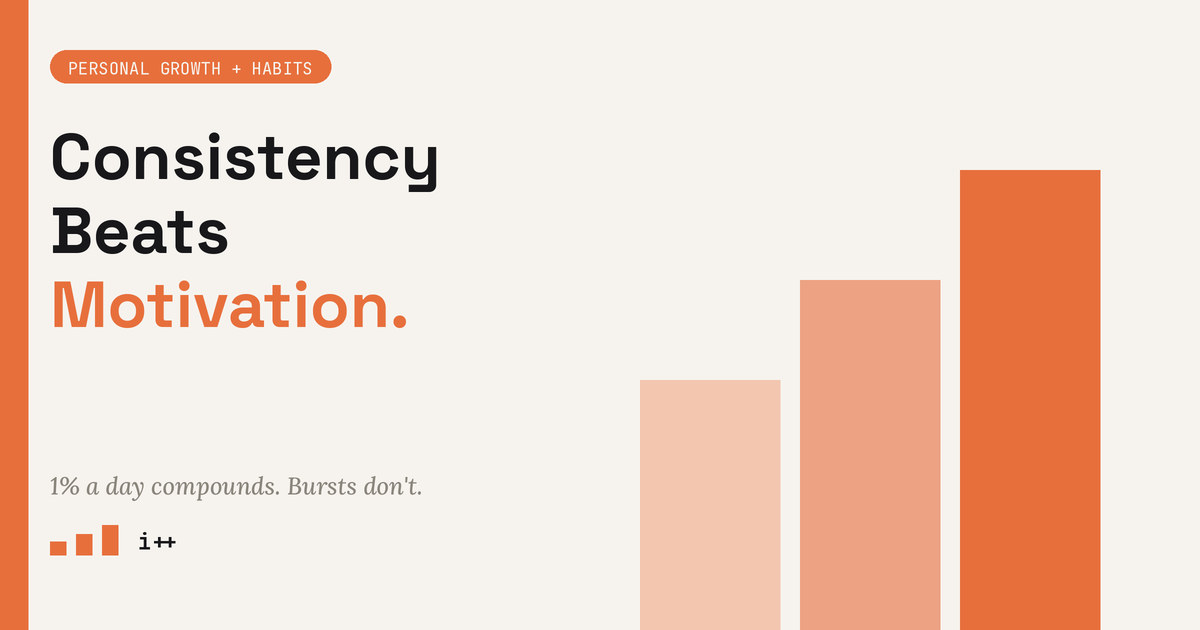
Motivation is a mood, and moods are unreliable by definition. What actually changed my body over the last year plus, was not a single motivated day. It was hundreds of average, sometimes barely-there days that I showed up for anyway.
This post is about why that works, and there is actual math behind it that made the whole thing click for me.
Motivation Is a Feeling. Feelings Don't Show Up on a Schedule
Motivation feels great when it's here. It also leaves without warning. It depends on how you slept, whether your day at work went sideways, whether someone said something that put you in a bad mood. None of that is in your control, which means if your habits depend on motivation, your habits are being run by things you don't control.
Consistency is different. Consistency is a decision you make once, in advance, about what you'll do regardless of how you feel that day. It's boring by design. That's the point. Boring is repeatable, and repeatable is the only thing that compounds.
The Math Nobody Shows You: 1.01 to the Power of 365
This is the part that actually rewired how I think about small effort.
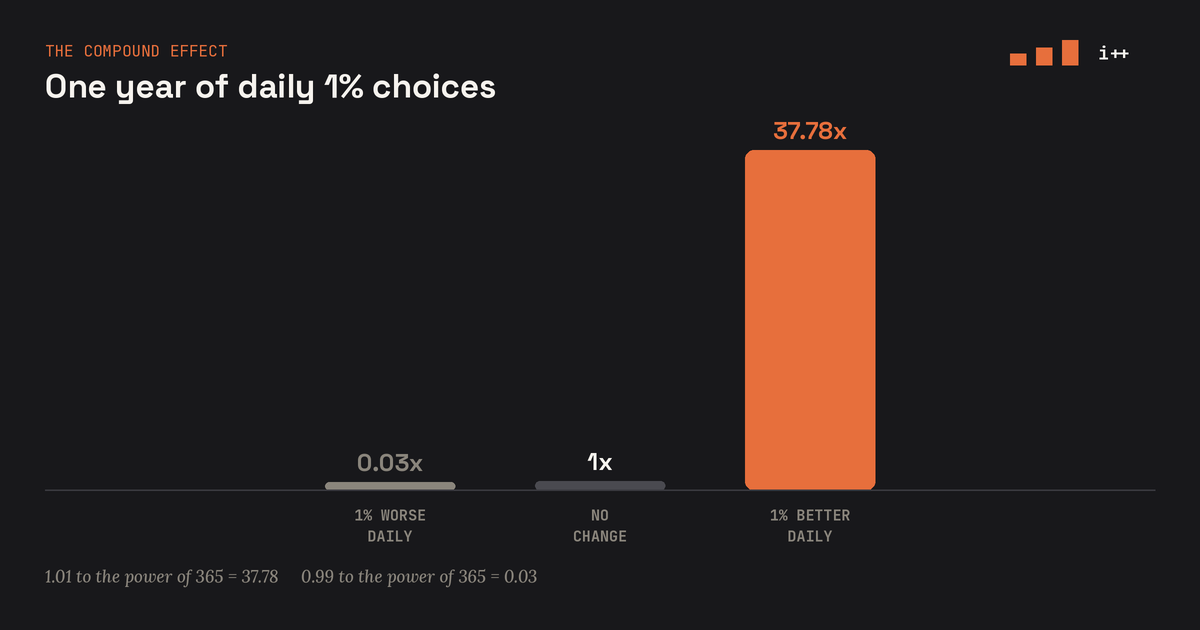
Take the number 1.01, meaning 1 percent better than where you started. Now raise it to the power of 365, one for every day of the year.
1.01^365 = 37.78
Show up and do 1 percent better, 1 percent more consistent, or 1 percent more disciplined than yesterday, every single day for a year, and you don't end up 365 percent better. You end up almost 38 times better. That is what compounding does. It doesn't add, it multiplies.
That's the entire argument for consistency in one equation. It's not that one motivated workout does more than one lazy day. It's that the direction you lean, repeated enough times, decides almost everything. Small and steady beats big and occasional because small and steady is the only one that survives 365 repetitions.
Why Your Body Trusts Repetition, Not Bursts
Your body doesn't respond well to chaos. It responds to a pattern it can predict.
Think about what a single brutal gym session does versus what a moderate session done four times a week for a month does. The one brutal session mostly just leaves you sore and, if you're not careful, injured or so wiped out you skip the next three days to recover. Your body didn't get a clear enough signal to actually adapt, it just got shocked.

A moderate, repeatable session done consistently is a completely different signal. Your body sees the same demand show up again and again and it starts adapting to meet it, because it has learned this is the new normal, not a one-off event. That's true for training, and it's just as true for eating. A week of perfect eating followed by two weeks of chaos teaches your body nothing except that food supply is unpredictable, which if anything makes it hold on tighter. A daily pattern it can rely on, even an imperfect one, is what actually lets it let go.
This is the same idea I talked about in the TDEE post, your body is running on averages over time, not on any single day. It doesn't care how good Tuesday was if Wednesday through Sunday didn't show up too.
What Imperfect Consistency Actually Looks Like
I want to be clear about something, because this is where a lot of people trip up. Consistency does not mean perfect.
Imperfect consistency looks like this. You planned a 45 minute workout, you only had 15, so you did 15. You planned a home cooked dinner, the day fell apart, so you picked the least bad option on the menu instead of skipping the meal entirely or ordering the worst thing on it. You didn't hit your step goal, but you still took the stairs and parked further away. None of those are 10 out of 10 days. All of them are wins, because all of them kept the pattern alive.
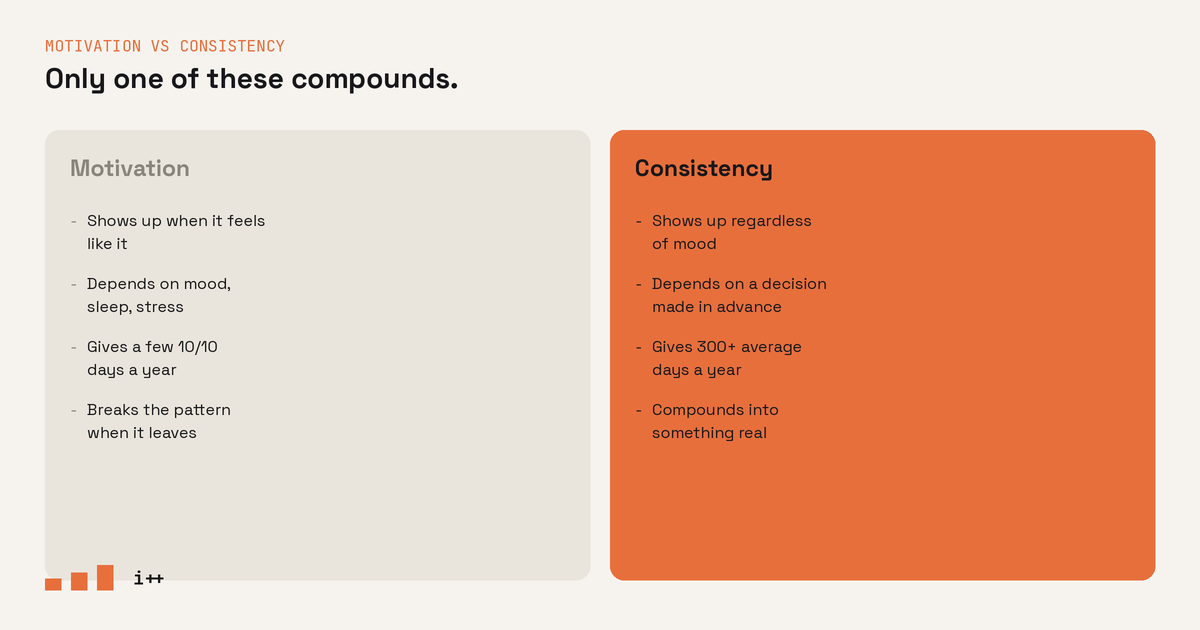
The version of you that shows up at 60 percent effort every day is building something. The version of you that shows up at 100 percent effort three times a month and zero the rest of the time is not, because there's no pattern there for your body or your brain to lock onto. It's just noise.
This is also why a flat scale for a few weeks doesn't mean nothing is happening, which I went deep on in the scale weight post. Consistency compounds quietly before it shows up loudly.
The 1 Percent Rule I Use When I Don't Feel Like Showing Up
On the days I don't feel like it, and there are plenty, I stopped asking myself "do I want to do the full thing." I started asking a smaller question instead.
Can I do 1 percent of it?
Can I do five minutes instead of forty five. Can I cook the soyabean even if I skip meal prepping the rest of the week. Can I take the walk around the block instead of the full route. The answer to the small question is almost always yes, and saying yes to the small version keeps the streak, the habit, and the identity alive. You can build on a small yes tomorrow. You cannot build on a hard no.
That's really the whole idea behind 1.01 to the power of 365. It was never about doing more. It was about not letting the pattern break.
The Takeaway
Motivation will get you to start. It will not get you to day 200. Consistency, even the imperfect, unglamorous, 60 percent kind, is the only strategy that survives contact with a real life and still compounds into something by the end of the year. Do the small version on the hard days. Let the math do the rest.
Consistency gives you the repetitions. A program gives them a direction. If you want that part decided for you, PPL vs 5/3/1: How Each Program Applies Progressive Overload breaks down how two proven programs build progress into the structure itself.
If you're building your own system instead of relying on willpower, start here with how I designed my environment for consistency, it pairs well with everything above.