How to Lose Fat Without Losing Muscle: The 5 Rules That Actually Matter
Most diets burn muscle right along with fat. Here are the 5 rules I use to lose fat without losing muscle: protein targets, training, and pacing that actually holds up.

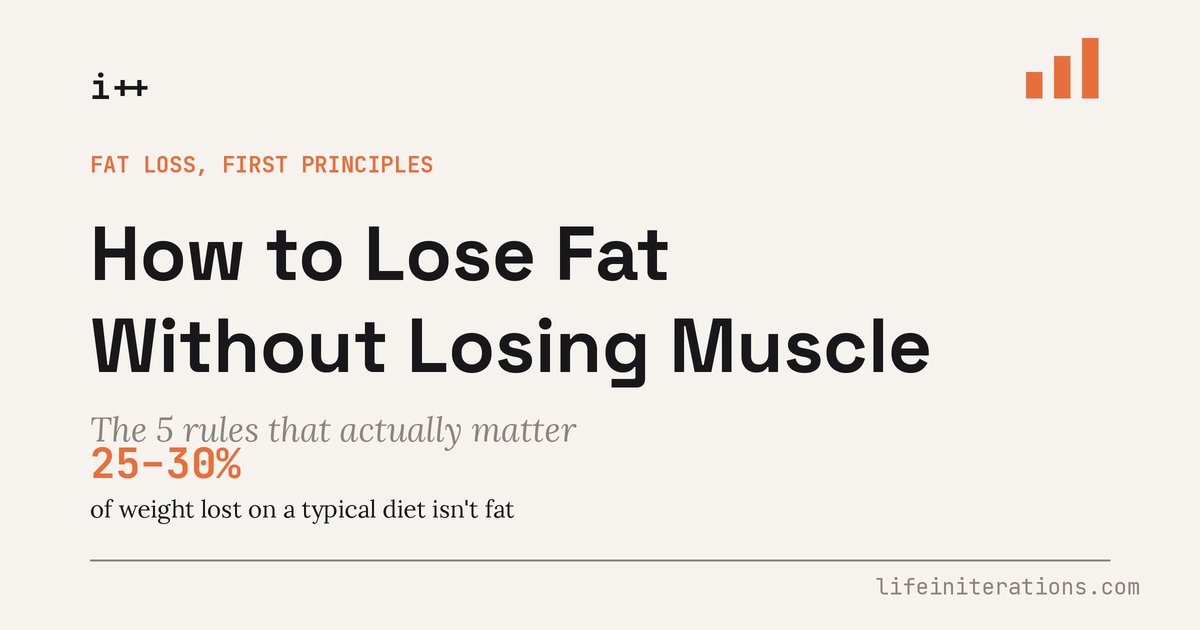
Up to 25 to 30 percent of the weight you lose on a typical diet isn't fat. It's muscle.
That gap, between what the scale shows and what actually happened to your body, is the whole problem with most weight loss advice out there. This post is about closing that gap. Here's how to lose fat without losing the muscle you worked hard to build.
Why You Lose Muscle in a Calorie Deficit
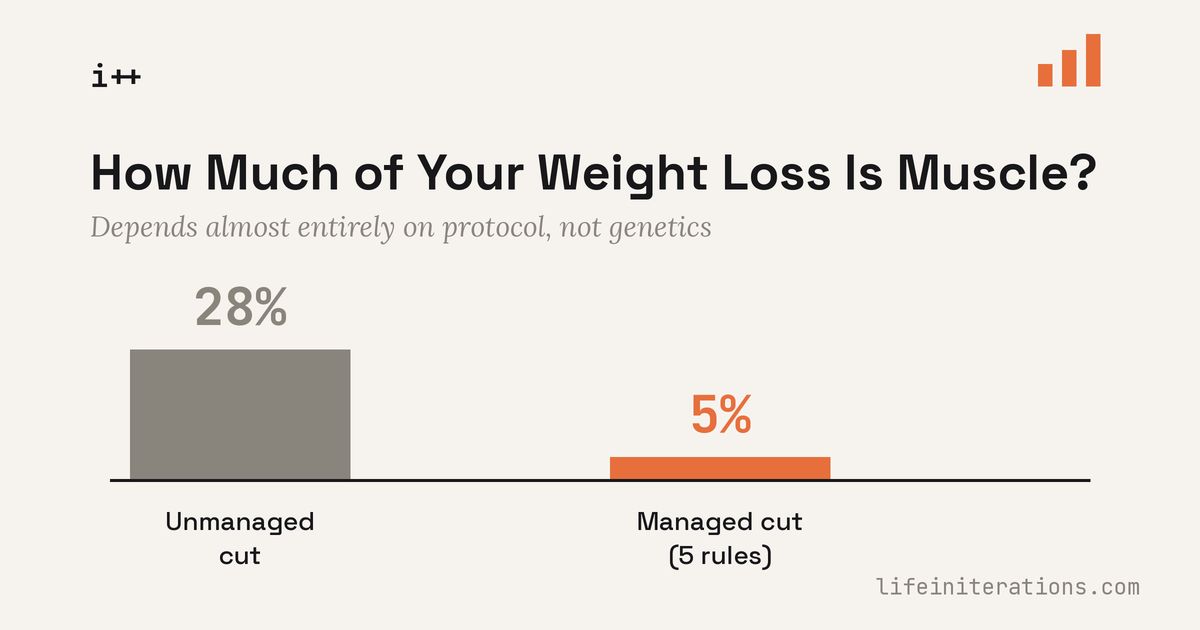
When you eat in a calorie deficit, your body has to make up the difference somewhere. Stored fat is the obvious target, but muscle is expensive to maintain too, and your body won't protect it automatically just because you'd like it to. If you give it no reason to hold onto that tissue (no heavy lifting, not enough protein) a chunk of it gets broken down for fuel right alongside your fat stores. The deficit itself isn't the enemy here. An unmanaged deficit is.
The 5 Rules to Preserve Muscle While Cutting
Rule 1: Keep Lifting Heavy
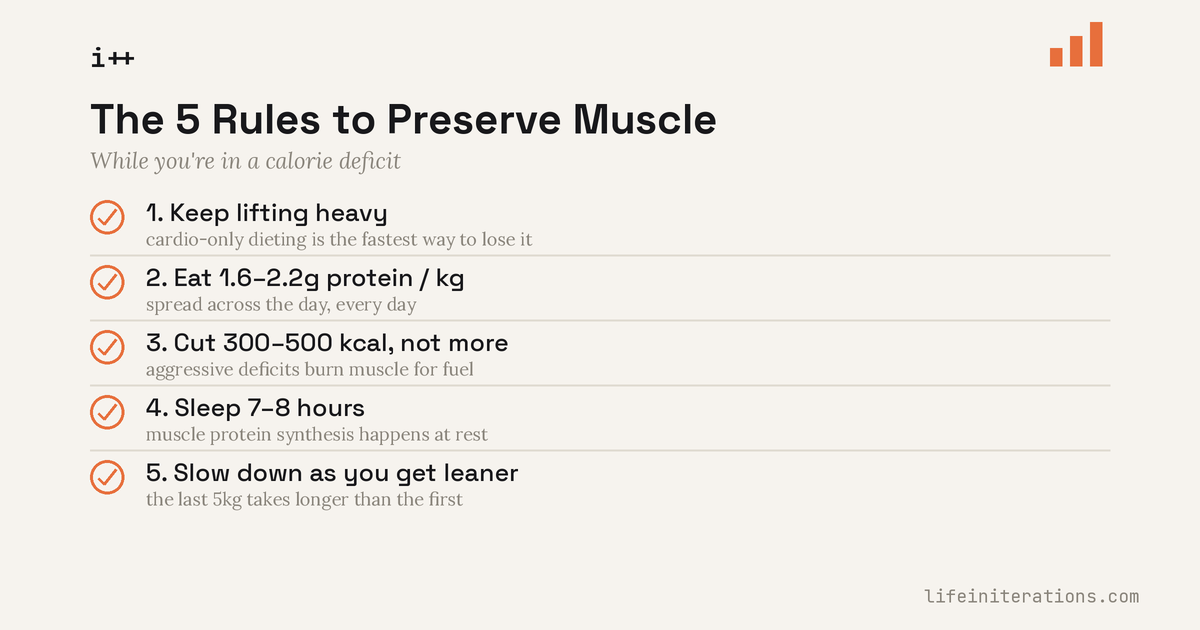
Your muscles respond to a simple signal: use it or lose it. Heavy resistance training tells your body "I still need this tissue," which is the biggest reason to keep lifting through a cut, not just before one. It's also why cardio-only dieting is the fastest way to lose muscle. Running or cycling burns calories, but it sends none of the "keep this muscle" signal that lifting does. If your current plan leans mostly on cardio with lifting as an afterthought, that's the first thing to fix.
You don't need to add training volume during a cut, and you probably shouldn't as your calories drop. What matters is keeping the intensity, the actual weight on the bar, as close as possible to what it was when you were eating at maintenance. For why that intensity matters more than volume, see Progressive Overload Explained: PPL vs 5/3/1.
Rule 2: Eat Enough Protein
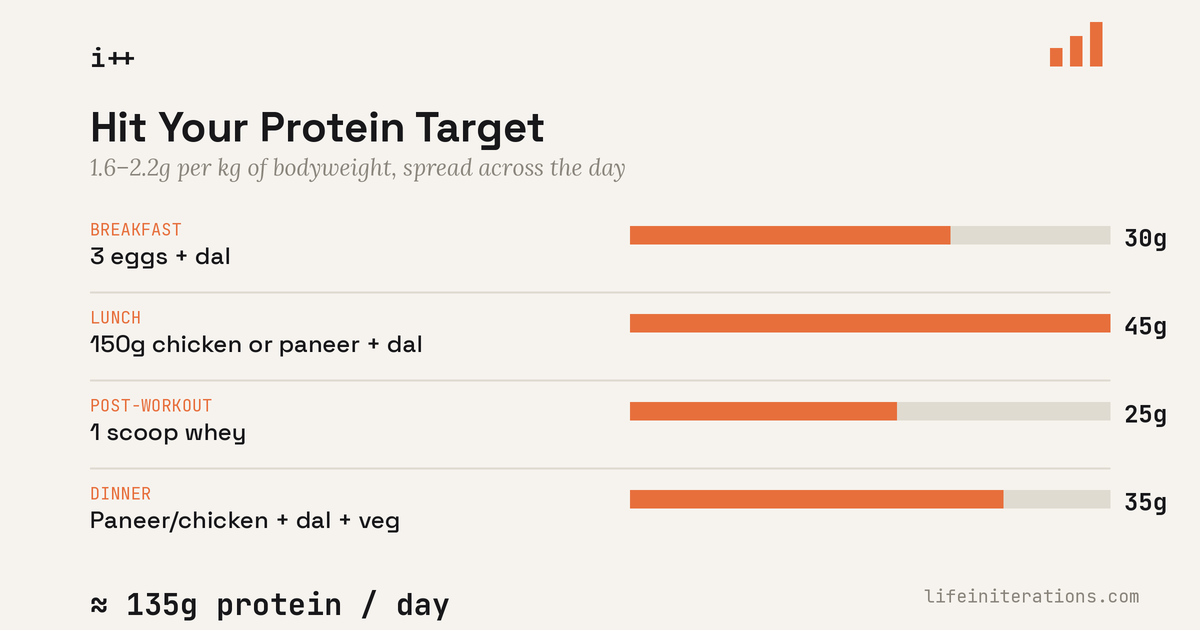
Protein is the raw material your body uses to repair and hold onto muscle while everything else is in short supply. The number that shows up again and again in the research is 1.6 to 2.2 grams per kilogram of bodyweight per day. For someone at 75 kg, that's roughly 120 to 165 grams spread across the day.
That's less intimidating than it sounds once you break it down. A day built around dal, paneer, eggs, chicken, and a scoop of whey after training gets most people there without much of a fight:
- Breakfast: 3 eggs plus a bowl of dal (roughly 30g)
- Lunch: 150g chicken or paneer with rice and dal (roughly 45g)
- Post-workout: 1 scoop whey (roughly 25g)
- Dinner: paneer or chicken again with dal and vegetables (roughly 35g)
I go a lot deeper on exact numbers, timing, and the myths around protein in this breakdown, since it's the rule most people underestimate the hardest.
Rule 3: Don't Crash Diet
A bigger deficit doesn't mean faster fat loss with the same muscle outcome. It means more muscle loss for a similar amount of total weight lost. A moderate deficit of 300 to 500 calories below maintenance is the range that shows up consistently in research as the sweet spot: fast enough to see real progress, small enough that your body doesn't panic and start cannibalizing muscle to cover the gap.
Aggressive cuts also backfire in ways that have nothing to do with muscle directly. Hunger climbs, workouts get worse, sleep suffers, and adherence usually falls apart within a few weeks. If you don't know your maintenance number yet, that's the actual starting point, not a percentage you saw on Instagram. I walked through how to calculate it properly in this post on TDEE.
Rule 4: Sleep and Recovery
Muscle isn't built or preserved in the gym. It's built at rest, when muscle protein synthesis actually happens. Skimp on sleep and two things work against you at once: cortisol rises, which favors muscle breakdown, and your body has less recovery time to repair what training just broke down. Aim for 7 to 8 hours consistently, especially during a cut, when you have less energy available to compensate for poor recovery.
Rule 5: Slow the Cut as You Get Leaner
This is the rule almost nobody talks about. The leaner you get, the faster you lose muscle relative to fat if you keep cutting at the same rate. Your body has less fat left to pull from, so it leans harder on muscle to close the same calorie gap. The fix is to slow down as you get closer to your goal: a smaller deficit, the occasional diet break at maintenance, and more patience than you needed in month one. The last 5 kg should take noticeably longer than the first 5 kg. That's normal, not a sign you're doing something wrong.
What Happens When You Get This Wrong (and Right)
My first cut, I got this wrong in almost every way possible. I cut calories hard, dropped lifting volume because I figured I was "saving energy for cardio," and treated protein as an afterthought. I lost 6 kg in six weeks and felt genuinely proud of that number, until I noticed my top set on bench had dropped by 10 kg and my shirts fit worse across the shoulders despite fitting better at the waist. That was the wake-up call.
Second time around I flipped almost everything. Deficit stayed around 400 calories, protein sat at 160g minimum every single day, and I never let a working set drop below what I'd hit at maintenance. I lost weight slower, about 4 kg over eight weeks, but every kilogram down showed up as a visible difference, not a strength chart going the wrong direction.
Slower and intact beat fast and hollow, by a wide margin.
The Bottom Line
Lift heavy, eat enough protein, and cut slow. That's the whole protocol compressed into six words, and if you only take one thing from this post, make it that.
If you're not sure where to start, figure out your maintenance calories first with this TDEE breakdown, then build your protein target from this post. Everything else here is detail layered on top of those two numbers.
What's actually working, or not working, in your current cut? Drop a comment, I read all of them.
FAQ
Can you build muscle and lose fat at the same time?
Yes, for two groups especially: beginners in their first year of lifting, and anyone returning to training after a long break. Both groups can add new muscle even in a calorie deficit because their bodies have unusually high adaptive potential right now. It's called body recomposition, and if you fit into one of those categories, high protein plus heavy lifting plus a small deficit is genuinely one of the most efficient phases of training you'll ever run.
How much muscle do you lose when cutting?
It depends heavily on how the cut is run. On an unmanaged diet with little training and low protein, muscle can make up a quarter to a third of total weight lost. Follow the five rules above (adequate protein, heavy lifting, a moderate deficit, good sleep) and that number drops dramatically, often into the single digits as a share of total loss. The gap between those two outcomes is mostly a matter of protocol, not genetics.
Is cardio bad for muscle?
Not inherently. Moderate cardio, a few short sessions a week, fits fine alongside lifting and can even help recovery by improving blood flow. The problem shows up when cardio becomes the primary tool for creating a deficit instead of a supporting one, especially if it starts eating into recovery time or replacing lifting sessions altogether. Keep lifting as the priority and cardio as the accessory, not the other way around.
Does fasting cause muscle loss?
Fasting itself, including intermittent fasting windows like 16:8, doesn't appear to cause extra muscle loss compared to eating the same calories spread across more meals, as long as total protein and training stay consistent. Extended fasts of 24 hours or more are a different story, since they make it much harder to hit a protein target and can push you toward a bigger deficit than intended.