The Number I Wish I Knew on Day One: TDEE
I lost 20+ KGs starting with one number: TDEE. Here is what it is, how to calculate yours, and why it is the only place to start your fat loss journey.

I started my fitness journey in March 2025. The goal was there but there was no clear path to achieve it. I used to struggle with finding the right kind of information because, frankly, the internet is scattered with fitness content that ranges from half-baked advice to outright myths.
So I decided to settle this once and for all. I visited a registered nutritionist and the way the doctor explained things to me, it not only made sense but helped me stay on the right path and actually achieve my goals. At the time of writing, I am already down by 20+ KGs compared to where I started.
No fluff, no supplements, no miracle routines. Just the actual science behind what works, starting from the very foundation.
And the foundation is one number: TDEE.
What is TDEE?
TDEE stands for Total Daily Energy Expenditure. It is the total number of calories your body burns in a single day. Everything included. Breathing, walking, thinking, working out, digesting food.
Think of it as your body's daily energy budget. The rules are simple:
- Consistently consume fewer calories than your budget: you lose weight
- Consistently consume more calories than your budget: you gain weight
- Match it exactly: your weight stays the same
That is the whole game. Everything else in nutrition and fitness is just context wrapped around this one equation.
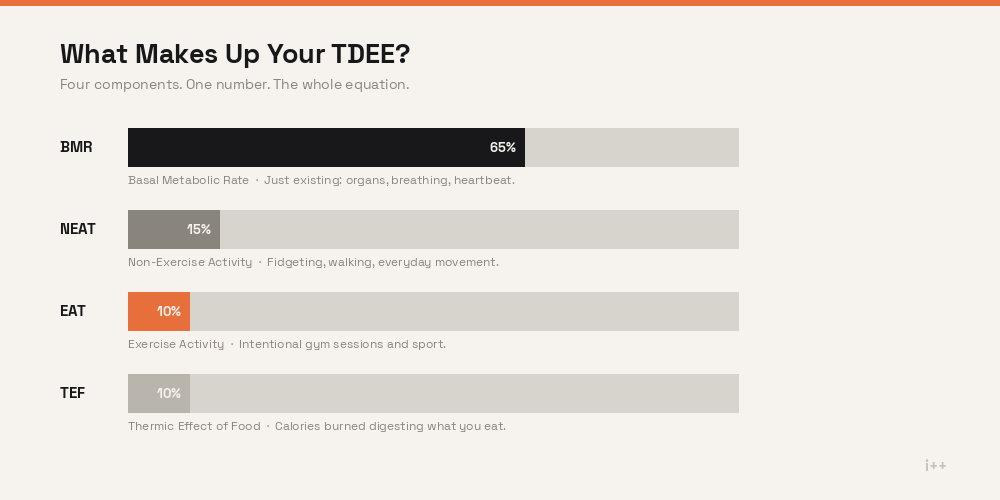
How Do I Calculate and Track My TDEE?
You calculate TDEE in two steps: find your BMR first, then adjust for your activity level.
Step 1: Calculate Your BMR
The most accurate formula for most people is the Mifflin-St Jeor equation:
For men:
BMR = (10 × weight in kg) + (6.25 × height in cm) - (5 × age) + 5
For women:
BMR = (10 × weight in kg) + (6.25 × height in cm) - (5 × age) - 161
Quick example: A 28-year-old man, 95 kg, 175 cm tall.
BMR = (10 × 95) + (6.25 × 175) - (5 × 28) + 5
    = 950 + 1093.75 - 140 + 5
    = 1,908 calories
This is how many calories his body burns daily just to exist. No movement included yet.
Step 2: Multiply by Your Activity Level
Using our example, if this person exercises 3 to 4 times a week:
TDEE = 1,908 × 1.55 = 2,957 calories
This is his maintenance number. To lose fat, he needs to consistently eat below this.
A word of caution here: Most people pick an activity multiplier that is one level higher than reality. Be honest with yourself. It is better to start conservative and adjust up than to overestimate and wonder why the scale is not moving.
The Deficit That Actually Works
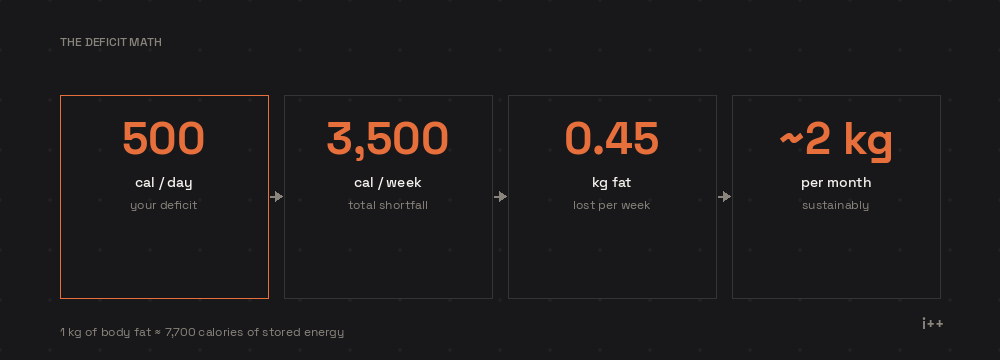
A calorie deficit of 300 to 500 calories per day is the sweet spot for sustainable fat loss.
Here is the math behind it: 1 kg of body fat stores roughly 7,700 calories of energy. A 500 calorie daily deficit creates a 3,500 calorie weekly deficit, which equals roughly 0.45 kg of fat loss per week. That is about 1.5 to 2 kg per month, consistently.
Going too aggressive (a 1,000+ calorie deficit) tends to backfire. You lose muscle alongside fat, your metabolism adapts downward, hunger becomes unmanageable, and the whole thing collapses within weeks.
Slow and steady is not just a saying. It is what the numbers support.
How to Track It
You do not need any expensive equipment or complicated setup. I just use pen and paper 🙂, you can also use a TDEE calculator like tdeecalculator.net or apps like Cronometer or MyFitnessPal. They handle the math for you.
Log your food. Especially for the first few weeks. Not forever, but long enough to calibrate your understanding of portion sizes and calorie density. Most people are shocked by what they discover.
Weekly weigh-ins. Weigh yourself at the same time each morning (after waking up, after bathroom, before eating) and take a weekly average. Daily fluctuations from water, salt, and hormones are just noise. The weekly trend is the signal.
Recalculate every 4 to 6 weeks. As you lose weight, your BMR drops because you are carrying less mass. Your TDEE from month one is not your TDEE from month three. Keep chasing that number down as you make progress. This is the step most people miss.
Can I Eat Anything to Meet My Goals?
The answer may shock you: Absolutely! If your TDEE is 2,500 calories and you eat 2,000 calories of pizza every day, you will lose weight. This concept is called IIFYM (If It Fits Your Macros) and there is solid science behind it.
However, the food you choose matters a lot for two reasons: satiety and sustainability. Some concepts to help you choose your food:
- Protein is Non-Negotiable
- Volume Eating is Your Best Friend
- Monitor your liquid calories closely
Conclusion
TDEE is not a hack or a shortcut. It is the underlying math that governs how your body changes. The reason it changed everything for me is that it replaced vague advice with a concrete, personal number I could actually act on.
TDEE tells you how much to eat. It does not tell you how to train, and in a deficit the training is what decides whether the weight you lose is fat or muscle. PPL vs 5/3/1: How Each Program Applies Progressive Overload covers the training side, and the five rules for losing fat without losing muscle covers how the two fit together.
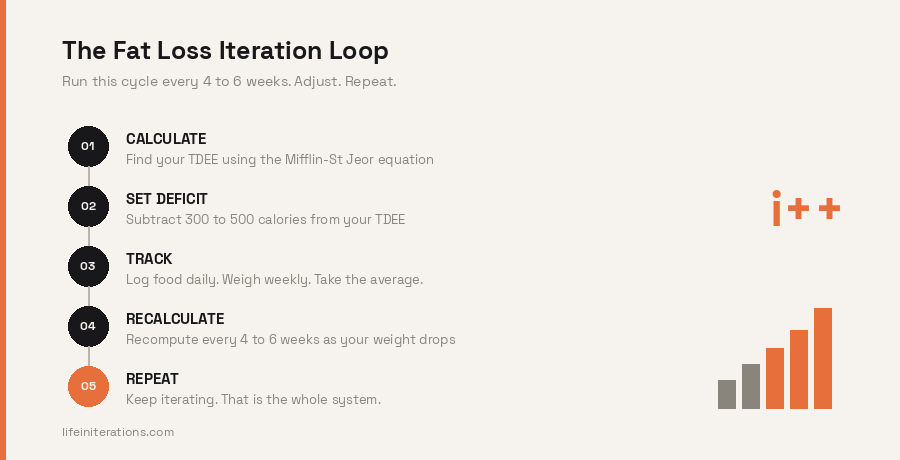
Here is the iteration loop that has driven my 20+ KG loss:
- Calculate your TDEE
- Set a 300 to 500 calorie daily deficit
- Track your food and weekly weight average
- Recalculate every 4 to 6 weeks as your weight changes
- Repeat
No magic. No secret protocol. Just a number and the discipline to keep iterating on it.
In the next post I am diving into macros: what protein, carbohydrates, and fat actually do, how I split mine, and why getting protein right is probably the single highest-leverage change you can make.
If this post helped you, share it with someone still swimming in conflicting fitness advice. Drop your questions in the comments, I read every single one.