Creatine for Fat Loss: What It Actually Does to Your Reps, Muscle, and Brain
Everyone talks about creatine for lifting. Almost nobody talks about the extra reps, how it helps with fat loss, the muscle it protects during a cut, or what it might be doing for your brain along the way.

Creatine does not burn fat. I want to get that out of the way in the first line, because half the internet will tell you it is a metabolism-boosting weight loss hack and the other half will tell you it is just for meatheads trying to get bigger. Neither one is being straight with you.
What creatine actually does is more interesting than "burns fat," and after months of taking it consistently through a cut, I think it earns a spot in this series even though its connection to fat loss is indirect. Here is the honest version: how it works, what changed in my training, the myths I used to believe, and a brain benefit almost nobody in the fitness space talks about.
Let's Get the Fat Loss Question Out of the Way
Think about what happens when you cut calories. Your body needs energy from somewhere, and without a strong enough signal to protect your muscle, it will happily burn some of that tissue right alongside your fat stores. I wrote about this in detail in the five rules for losing fat without losing muscle, and creatine slots directly into rule one: keep lifting heavy. It does that by giving your muscles more fuel to push those heavy sets, so you can keep the intensity up even when your calories are down.
The scale might tell a confusing story in the first week. Creatine pulls water into your muscle cells, which can show up as one to three kilograms of "weight gain" almost overnight. That is not fat. It is water sitting inside the muscle, and it is actually a sign the supplement is doing its job.
How Creatine Actually Works
Your muscles run on ATP, and ATP runs out fast during anything heavy or explosive. Your body's backup battery for this is a compound called phosphocreatine, which regenerates ATP almost instantly so you can keep pushing through a set instead of grinding to a halt. Supplementing with creatine raises your muscle's phosphocreatine stores by somewhere between fifteen and forty percent, depending on your starting levels and diet.
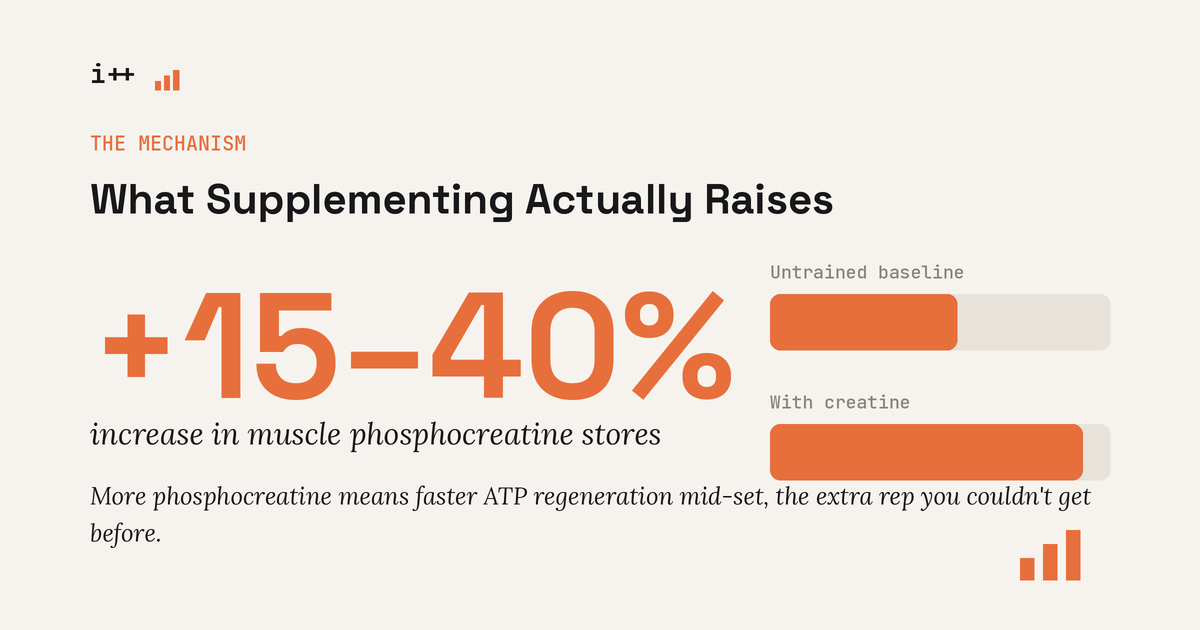
That extra buffer matters most for short, intense efforts: a heavy set of squats, a sprint, a max-effort lift. It matters a lot less for a long, steady run, which is why creatine is a strength and power supplement first and an endurance supplement a distant second.
Those extra reps only matter if the load keeps climbing over time. That is progressive overload, and PPL vs 5/3/1: How Each Program Applies Progressive Overload covers how two proven programs build it into the plan instead of leaving it to memory.
The Myths I Used to Believe
Creatine is one of the most studied supplements that exists, with well over a thousand trials behind it, and it still gets treated like a shady bodybuilding secret. Here is what the research actually says about the concerns that kept me from trying it for years.
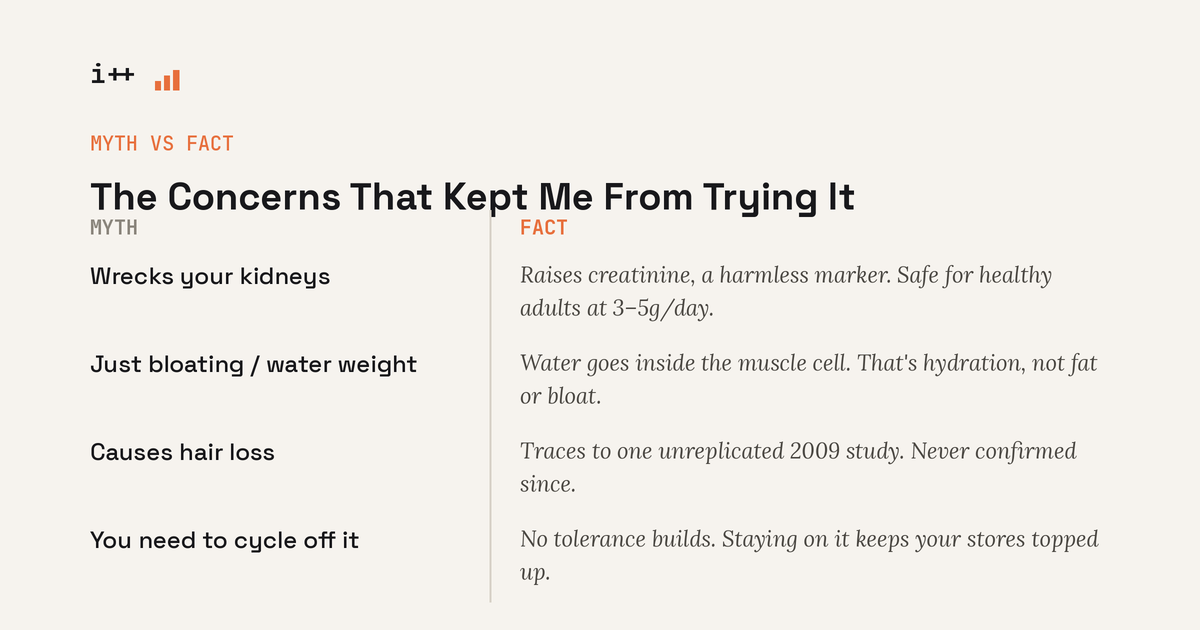
"It wrecks your kidneys"
This one comes from a genuine but misunderstood lab result. Creatine supplementation raises creatinine, a waste product your body clears through the kidneys, and doctors sometimes use creatinine as a rough proxy for kidney function. Higher creatinine from creatine use looks alarming on paper, but it does not reflect actual kidney damage. Decades of research in healthy adults show no harmful change in kidney function at the standard three to five gram daily dose. If you already have kidney disease, that is a real conversation to have with a doctor first. Otherwise, this myth does not hold up.
"It's just water weight and bloating"
Partly true, entirely misunderstood. The water creatine pulls in goes inside your muscle cells, not under your skin. That is muscle hydration, not the kind of bloating that makes you look puffy. It also is not fat, no matter how the scale reads that first week.
"It causes hair loss"
This myth traces back to a single small 2009 study on rugby players that found a temporary rise in a hormone linked to hair loss. It has never been reliably reproduced since, and a recent trial that directly measured hair density and follicle health over twelve weeks found no effect. If creatine caused baldness, every serious lifter would be shiny-headed by thirty.
"It's basically a steroid"
Creatine and anabolic steroids share nothing in common structurally or mechanically. Steroids are synthetic hormones that alter your endocrine system. Creatine is a compound your own liver and kidneys already make, and that you already eat every time you have red meat or fish. It is not banned by any major sporting body, for good reason.
"You need to cycle off it"
There is no tolerance to build and no receptor to down-regulate. Creatine works by topping up a storage pool in your muscles, and staying consistently supplemented keeps that pool full. Cycling off just means giving up the benefit for no real reason.
How I Actually Take It
Nothing complicated here, which is honestly part of the appeal.
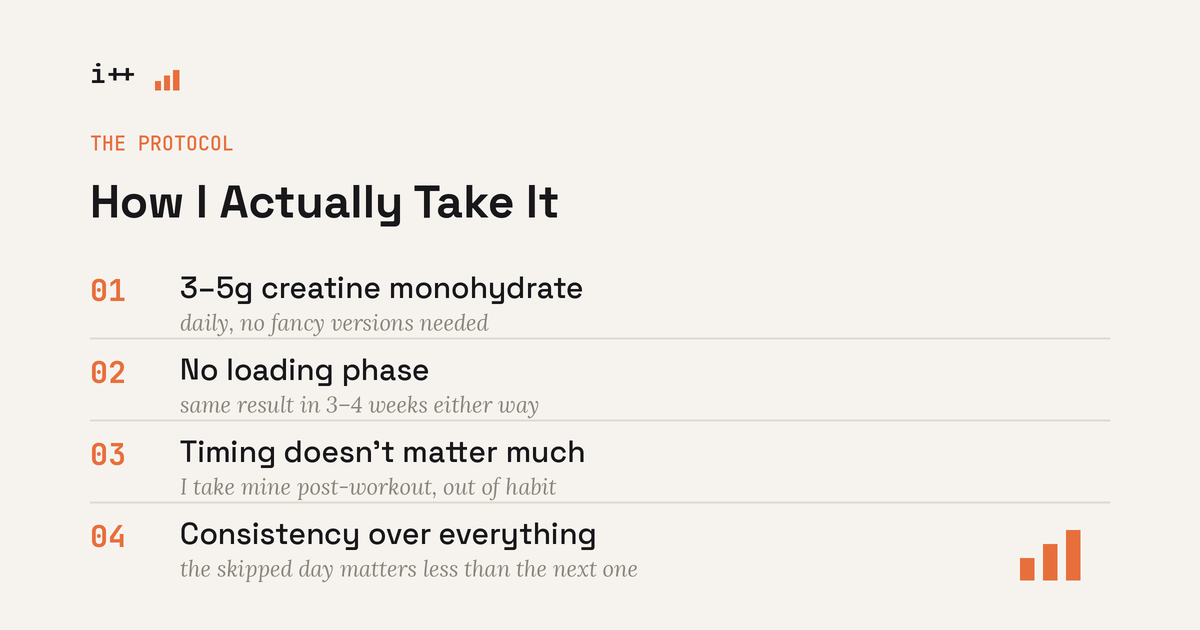
- Three to five grams of creatine monohydrate daily. Not the fancy ethyl ester or HCL versions, monohydrate has the most research behind it and the lowest price tag by far.
- No loading phase. The twenty gram loading protocols saturate your muscles faster, but a consistent daily dose gets you to the same place within three to four weeks.
- Timing does not matter much. I take mine with my post-workout shake because it is easy to remember, not because the science demands it.
- Drink normally. The old advice to drink extra water on creatine is not backed by anything solid, just drink like a normal, reasonably hydrated adult.
- Consistency beats everything else on this list. The whole mechanism depends on keeping your muscle stores topped up, so the days you skip matter less than whether you are back on it the next day.
If you have pre-existing kidney disease, are pregnant, or are on medication that affects kidney function, talk to a doctor before adding this in. For everyone else, this is about as low-risk as supplements get.
Where This Fits in the Bigger Picture
Creatine is not going to replace knowing your actual maintenance calories or hitting your protein target. It is not going to substitute for lifting heavy through a cut either. What it does is sit quietly underneath all of that, protecting the muscle those other pieces are working to build, and giving you a little more in the tank on the sets that actually drive progress.
Fat loss was never really about the supplement stack. It is about the training, the food, and the sleep. Creatine just makes the training part hold up a little better while everything else does the real work.
Are you taking creatine, or still on the fence about it? Drop a comment, I read all of them.
FAQ
Does creatine help you lose fat?
Not directly. Creatine does not burn fat or create a calorie deficit on its own. It supports fat loss indirectly by helping you maintain training intensity and preserve lean muscle mass while you are in a deficit, which improves your overall body composition even when the scale does not move as fast as you would like.
Is creatine bad for your kidneys?
Not for healthy adults. Creatine raises creatinine, a marker sometimes used to estimate kidney function, but this reflects normal creatine metabolism rather than kidney damage. Decades of research show no harmful effects at standard doses of three to five grams per day. Anyone with existing kidney disease should still check with a doctor first.
Does creatine cause hair loss?
There is no solid evidence for this. The concern traces back to a single small study from 2009 that has never been reliably replicated, and more recent research directly measuring hair health found no effect.
Should I take creatine if I don't lift?
Possibly, yes. Beyond muscle and strength, creatine supports the same energy system your brain relies on, and research links it to modest improvements in memory and processing speed regardless of training status. If you are not lifting, you will not get the training-performance benefits, but the potential cognitive benefit is not conditional on being in the gym.