PPL vs 5/3/1: How Each Program Applies Progressive Overload
Your muscles do not care how hard you worked today. They care whether today was harder than last time — that's called progressive overload. Here's the principle behind every good program, and how PPL and 5/3/1 put it to work.

I used to think I was training hard. Same five exercises, same weights, three days a week, for almost two months straight. I left every session sweaty and sore, which felt like proof I was doing something right. My arms disagreed. Nothing changed.
The problem was not effort. It was that my muscles had already figured out my routine. Once a stimulus stops surprising your body, it stops building anything new. The fix has a name, and it is the single most important concept in strength training: progressive overload.
This post breaks down what progressive overload actually is, why your muscles need it to grow, and how two of the most trusted training systems out there, push pull legs (PPL) and Jim Wendler's 5/3/1, build it directly into their structure so you are not left guessing.
What Progressive Overload Actually Means
Progressive overload is the gradual, deliberate increase of demand you place on your muscles over time. That demand can come from more weight, more reps, more sets, less rest, better range of motion, or a slower tempo. The specific lever does not matter as much as the pattern: this week has to ask a little more of your body than last week did.
Think of it like studying for a test. Reading the same chapter ten times does not prepare you for harder questions. You have to keep raising the difficulty, a bit at a time, so your brain has a reason to adapt. Muscle works the same way. Lift the same weight for the same reps forever, and your body settles into "maintenance mode." It has already adapted to that stress, so there is nothing left to adapt to.
The Methods of Progressive Overload
You do not need to add weight every single session to be progressing. Here are the main levers, roughly in order of how most lifters use them:
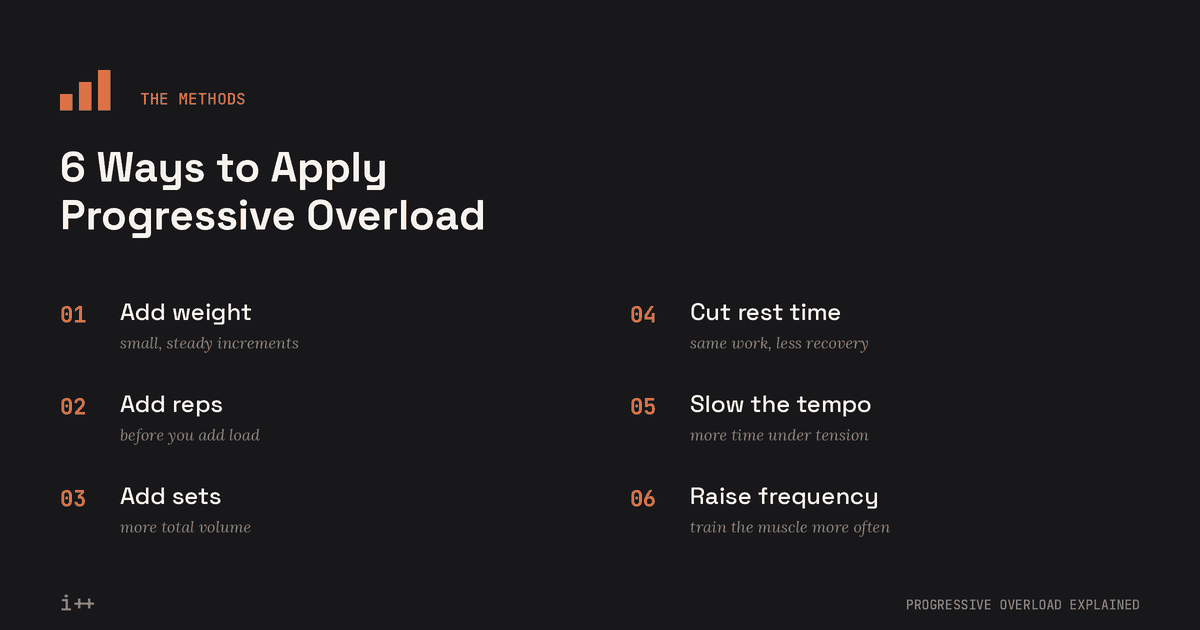
- Add weight. The classic method. Once a weight feels manageable for your target reps, add a small increment, 2.5 to 5 lbs for upper body, 5 to 10 lbs for lower body.
- Add reps. Stay at the same weight but push your rep count up before increasing load. Common approach when weight jumps feel too big.
- Add sets. More total volume at the same weight and reps. Effective for hypertrophy, though it costs more recovery.
- Reduce rest between sets. Doing the same work in less time increases density and conditioning.
- Improve tempo and range of motion. A slower eccentric or a deeper squat increases time under tension without touching the weight on the bar.
- Increase frequency. Training a muscle group more often per week, provided total recovery can keep up.
The mistake most beginners make is fixating only on the first one. If you cannot add weight this week, add a rep. If you cannot add a rep, slow down the tempo. There is almost always a lever left to pull, and a good program picks the right one for you instead of leaving it to guesswork.
Two Programs, Same Principle: PPL and 5/3/1
Understanding progressive overload is one thing. Applying it consistently, week after week, without just winging it in the gym, is where most people fall apart. This is exactly the gap that structured programs are built to close. PPL and 5/3/1 approach it from two different angles, and knowing how each one works will make it obvious which one fits where you are right now.
Push Pull Legs (PPL) and Progressive Overload
PPL splits your training week by movement pattern instead of by body part. Push day covers chest, shoulders, and triceps. Pull day covers back and biceps. Leg day covers quads, hamstrings, glutes, and calves. You can run it three days a week for beginners, or six days a week if you want to hit every muscle group twice.
Here is what a basic 5/6-day week looks like:
| DAY | FOCUS | EXAMPLE LIFTS |
|---|---|---|
| Push | Chest, shoulders, triceps | Bench press, overhead press, dips |
| Pull | Back, biceps | Deadlift, rows, pull-ups |
| Legs | Quads, hamstrings, glutes | Squats, Romanian deadlifts, lunges |
| Rest/Cardio | -- | -- |
| Upper | Chest, back and arms | Cable rows, Lat pulldown, overhead extension |
| Lower | Legs and shoulder | Leg press, dumbbell press |
PPL does not hand you a built-in progression scheme the way 5/3/1 does. That is intentional. It gives you the structure and the recovery windows, roughly 48 to 72 hours per muscle group, and leaves the overload method up to you. In practice, this usually means picking two or three main lifts per day to progress on weight week to week, then rotating accessory lifts through rep progression once weight jumps get too large to manage cleanly.
This is what makes PPL such a strong choice for hypertrophy. You get more total weekly volume per muscle group than most other splits, which gives you more opportunities to add a rep here or a set there. The tradeoff is that it requires more self-tracking, since nothing about the split itself tells you when to add weight.
The 5/3/1 Method and Progressive Overload
If PPL leaves the progression up to you, 5/3/1 does the opposite. Jim Wendler built progressive overload directly into the math.
The program runs on four main lifts: squat, bench press, deadlift, and overhead press, each getting its own day. You start by calculating a training max, roughly 85 to 90 percent of your true one-rep max, deliberately conservative so the program has room to work. Every four-week cycle follows the same rep scheme:
- Week 1: 3 sets at 65%, 75%, and 85% of training max, for 5, 5, and 5+ reps (the "+" means you push the last set for as many reps as you can)
- Week 2: Sets at 70%, 80%, and 90%, for 3, 3, and 3+ reps
- Week 3: Sets at 75%, 85%, and 95%, for 5, 3, and 1+ reps
- Week 4: Deload at 40%, 50%, and 60%, just to recover
At the end of each cycle, you add a small amount to your training max, typically 5 lbs for upper body lifts and 10 lbs for lower body lifts, and start the next cycle. The overload is not something you have to remember to apply. It is written into the structure of the program itself.
The AMRAP set (that "+" set) is also doing double duty. It is your progression stimulus for that session, and it is your feedback signal. If you are grinding out fewer reps than expected across a few cycles, that is your sign to reset your training max or take an extra deload. This is why 5/3/1 has stayed popular for over a decade. It removes the guesswork around "am I actually progressing," which is the exact question a lot of lifters struggle to answer on their own.
PPL vs 5/3/1: Which One Fits Your Goals
Neither program is objectively better. They are built for different priorities, and a lot of lifters end up using both at different points.
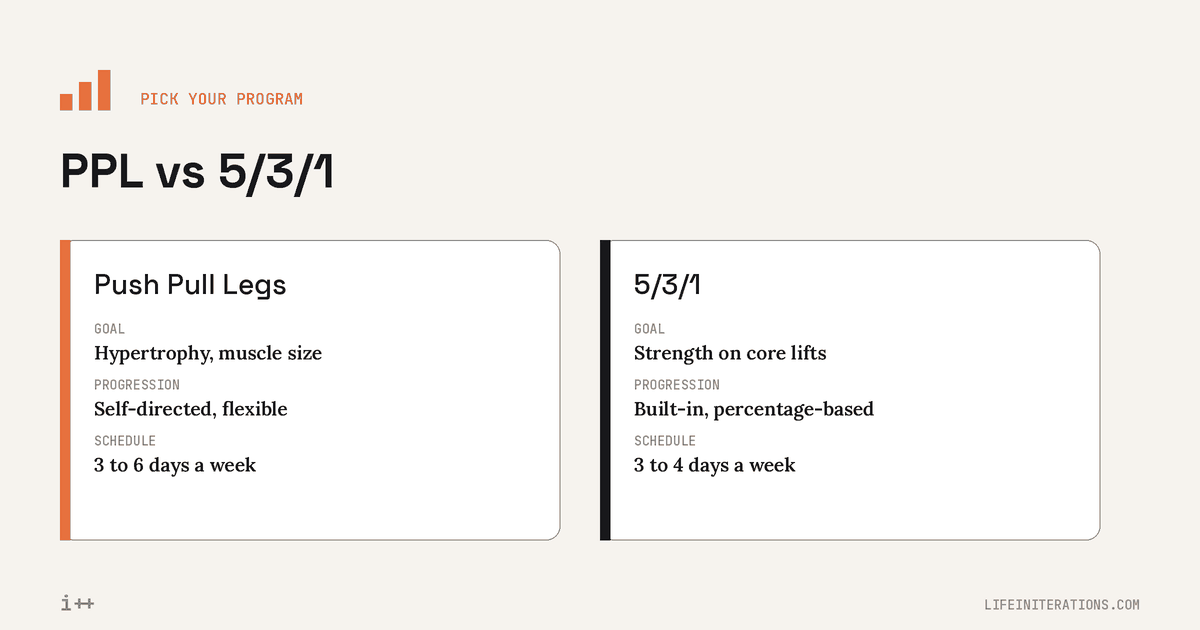
| PPL | 5/3/1 | |
|---|---|---|
| Primary goal | Hypertrophy (muscle size) | Strength on core lifts |
| Progression style | Self-directed, flexible | Built-in, percentage-based |
| Weekly volume per muscle | High | Lower, more focused |
| Time commitment | 3 to 6 days a week | 3 to 4 days a week |
| Best for | Lifters who want more say over exercise selection and volume | Lifters who want structure and less decision fatigue |
If your main goal is to look more muscular and you enjoy having variety in your exercise selection, PPL gives you the volume and flexibility to make that happen. If your goal is to get stronger on the big barbell lifts without having to think too hard about programming every week, 5/3/1 removes almost all the guesswork. Plenty of lifters run PPL for a hypertrophy block, then switch to a 5/3/1 cycle to consolidate strength gains, then go back. Both are just different tools for applying the same underlying principle.
Common Questions About PPL and 5/3/1
Can you run 5/3/1 with PPL accessories?
Yes, and it is one of the most common ways people run 5/3/1 once the bare program starts to feel thin on volume. Keep the four 5/3/1 main lifts exactly as written, squat, bench, deadlift, and overhead press on their percentage progression, then add PPL-style accessory work onto each day by movement pattern. Bench day picks up push accessories like dips, incline dumbbell press, and triceps work. Deadlift day picks up pull work, rows, chin-ups, and curls. Squat day picks up the leg work, lunges, leg press, and hamstring curls. You get the automatic progression of 5/3/1 on the lifts that matter most for strength, and the volume of PPL where it matters most for size. Wendler's own "Boring But Big" template is basically this idea formalized: the main lift, then five sets of ten on a matching accessory. The rule that keeps it from falling apart is the usual one. Progress the main lifts by the book, and let the accessories follow on rep progression, instead of trying to set a personal record on everything at once.
Is 5/3/1 or PPL better for beginners?
For a true beginner, the honest answer is that neither is ideal, and PPL is the riskier pick. Both assume you already know how to add weight sensibly and hold form under fatigue, and PPL in particular hands you every progression decision with no guardrails, which is a lot to ask of someone in their first few months. 5/3/1 is the safer of the two, because the math makes the decisions for you and the conservative training max keeps you away from ugly near-failure reps. Its one real drawback for a beginner is that it can progress slower than you are actually capable of, since early on you can often add weight every session while 5/3/1 only raises the training max once a month. If you are brand new, a simple linear-progression program usually beats both for the first six months or so. Come to PPL or 5/3/1 once your easy newbie gains dry up and you need real structure to keep moving. That is the point where the choice in the table above actually starts to matter.
The Bottom Line
Progressive overload is not a trick or a hack. It is the actual mechanism behind every pound of muscle you will ever build. PPL and 5/3/1 are just two well-tested ways of turning that principle into a program you can follow without reinventing your training plan every week. Pick the one that matches what you are chasing right now, track your numbers honestly, and let the small, boring increases do their job over months instead of days.
If you're running a cut alongside your training, this same principle is exactly why it matters to keep lifting hard, and heavy, while your calories are down. I cover the full protocol — training, protein, pacing — in How to Lose Fat Without Losing Muscle: The 5 Rules That Actually Matter.