Why the scale isn’t moving
The scale can stall for weeks while you’re still losing fat. Here’s what’s really happening on the scale, what to track instead, and why staying consistent through the flat weeks is the whole game.


Your Scale Is Lying to You
This is 15 months of my weight in one screen.
From 97 kg down to 77.2 kg. When you watch that line scrub from March 2025 to today, it looks like a clean, beautiful, inevitable downward slope.
It was not. That smooth line is a lie of hindsight.
When you zoom in on any single week of that line, the reality was messy. There were days the scale was flat. There were days it randomly spiked up. The chart only looks inevitable because it’s completely zoomed out.
The hard truth about weight loss? Most people never earn the zoomed-out view because they quit during a flat week.
Here is exactly what is happening when your scale is not moving, why you are likely still losing fat, and how to survive the psychological trap of the daily weigh-in.
Why the Scale Isn't Moving
To understand why the scale stalls, you have to remember one fundamental first principle: the scale measures total mass, not fat.
When you step on the scale, you are weighing your fat, yes. But you are also weighing your bones, your muscles, your organs, the water in your cells, the food currently digesting in your stomach, and the glycogen stored in your muscles.
If you are wondering why the scale isn't moving despite your calorie deficit, it is almost always due to the "noise" of these other factors:
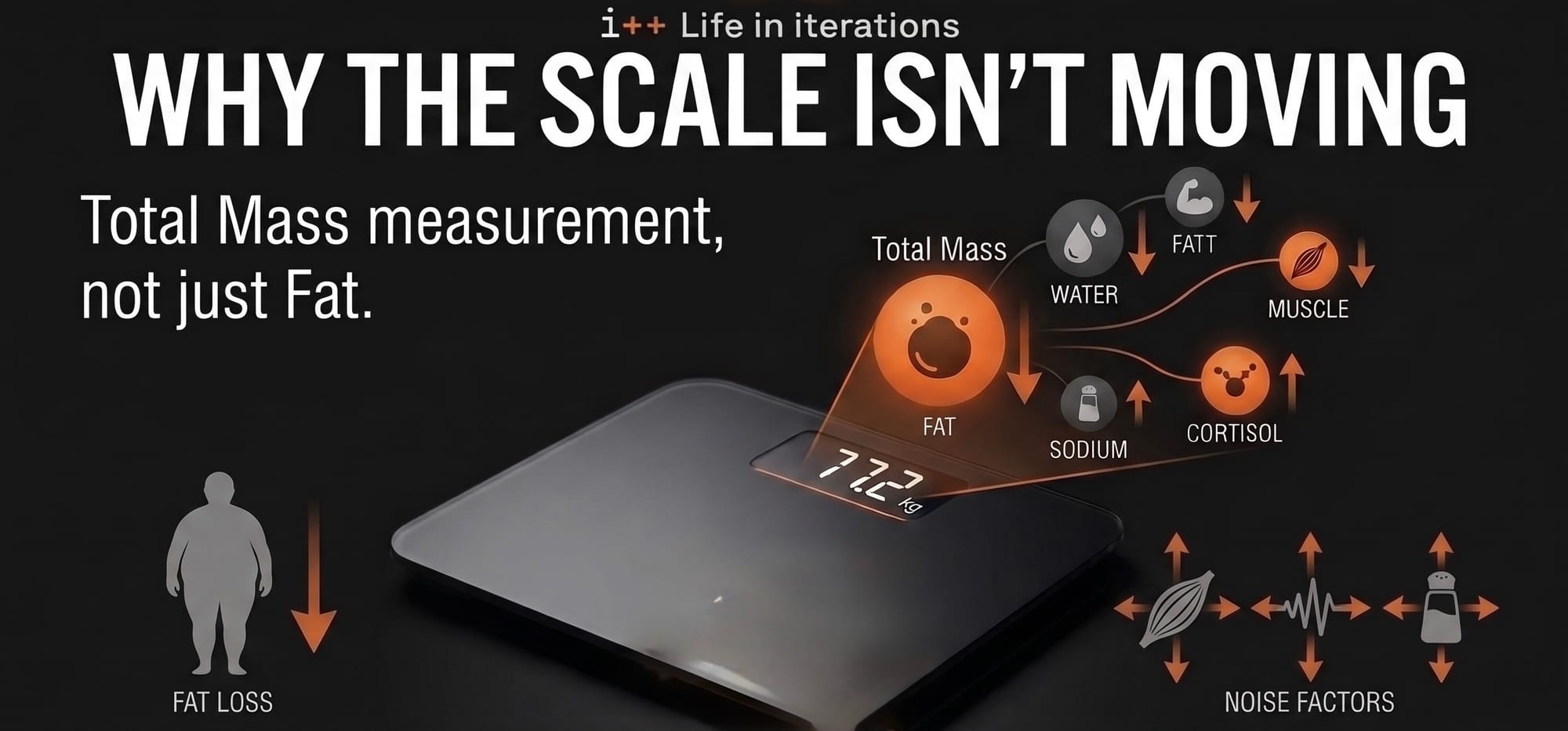
- Water and Glycogen: Carbohydrates pull water into your muscles. If you ate more carbs yesterday than the day before, your body is holding onto more water. You didn't gain fat overnight; you just filled your muscular gas tanks.
- Sodium Fluctuations: A salty meal will cause your body to temporarily retain water to maintain cellular balance.
- Stress and Sleep: High cortisol (from stress or poor sleep) directly increases water retention. If you are exhausted, your scale will stubbornly refuse to budge.
- A New Training Block: When you start a new workout program or push yourself harder in the gym, your muscle fibers experience micro-tears. Your body rushes fluid to the area to heal the inflammation, causing the scale to spike.
- Body Recomposition: If you are eating plenty of protein and lifting weights, you might be building muscle while simultaneously burning fat. Because muscle is denser than fat, the scale might stay perfectly flat even as you get noticeably leaner.
- The "Whoosh" Effect: Fat cells don't always shrink immediately when they empty of fat. Sometimes, they temporarily fill with water. You stay in a deficit, the scale doesn't move for ten days, and then—whoosh—you wake up one morning and suddenly drop two kilograms.
What is Actually Happening During a Stall?
When you are in a true calorie deficit, fat is going down. It has to; the laws of thermodynamics demand it. But while the fat is burning, water, glycogen, or new muscle tissue is quietly filling the gap on the scale.
The real work is happening underneath the one number you can easily see.
What to Track Instead of the Daily Number
If the daily scale weight is a liar, what should you look at? You need data points that cut through the daily noise.
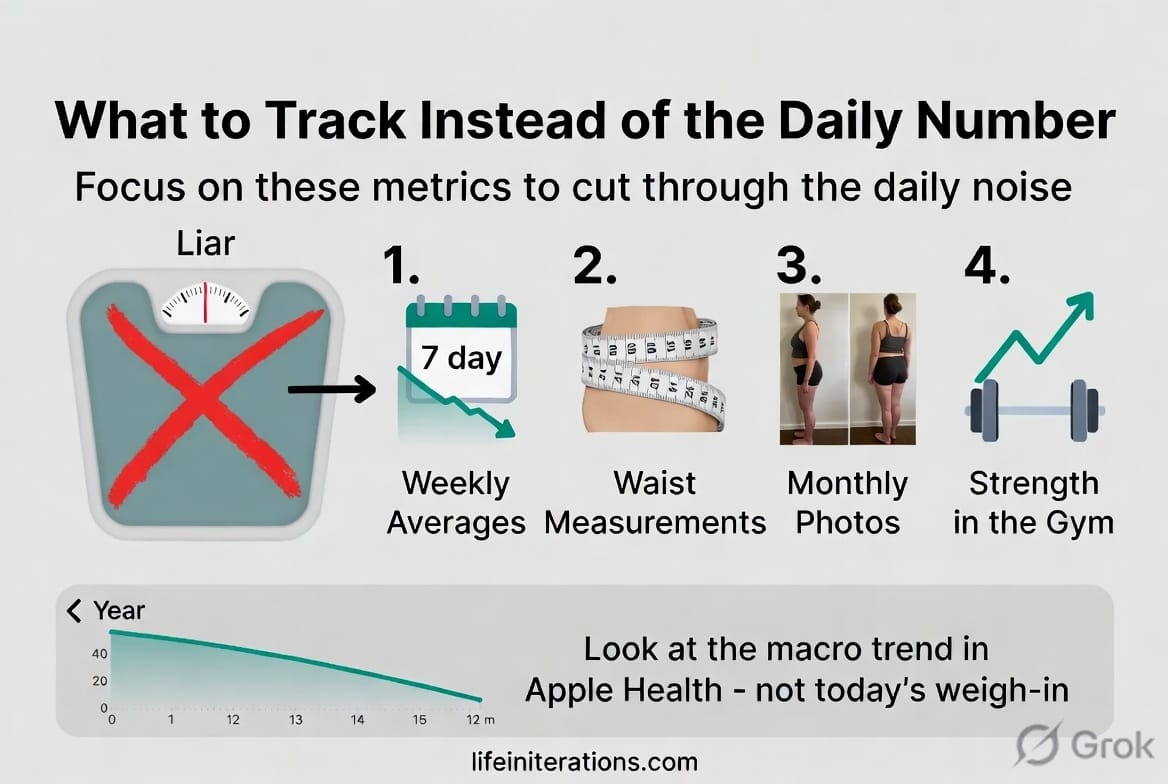
- Weekly Averages: Weigh yourself daily, but only care about the average at the end of the week. Compare Week 1's average to Week 2's average.
- Waist Measurements: Buy a cheap fabric tape measure. Your waist circumference will often shrink even when the scale is completely paralyzed.
- Monthly Photos: Take photos in the same lighting, at the same time of day, once a month. The mirror lies to you daily, but month-over-month photos do not.
- Strength in the Gym: If your lifts are going up or maintaining while you feel leaner, you are winning.
- How Your Clothes Fit: That pair of jeans getting looser around the thighs is a far better metric than a digital number in your bathroom.
This is exactly why I look at the Year view in Apple Health, not today’s weigh-in. You have to force yourself to look at the macro trend.
How to Know When a Stall is Actually Real
I want to be completely honest here. The takeaway of this post isn't "ignore the scale forever."
A few flat days is just biological noise. A flat week is normal. But if you have a genuinely flat trend line for 3 to 4 weeks, it is no longer water weight. It means your body has adapted, and you are no longer in a calorie deficit.
When you hit a true 3-to-4-week stall, it’s time to reassess your intake and your output. (Check out my complete guide on how to calculate and adjust your calorie deficit math here to break through a true plateau).
The Trend is Your Real Scoreboard
The flat weeks are incredibly frustrating. They test your patience, your ego, and your sanity. But the flat weeks are exactly where most people quit, and exactly where the final result is being built.
During this 15-month journey, I almost stopped during one of those stalls. I was putting in the work, I was hungry, and the scale was laughing at me. But I stayed consistent, I trusted the first principles, and eventually, the line caught up to my effort.
Look at that 77.2 kg frame at the end of the video. It didn't happen because I had perfect daily weigh-ins. It happened because I survived the flat weeks.
The scale isn’t the scoreboard. The trend is. Keep going.