I Tracked My Health with AI for 30 Days: What Actually Changed
I spent 30 days feeding my health data to an AI every single morning. Some things genuinely changed. Some things were pure theater. Here's the honest breakdown.

For 30 days straight, the first conversation I had every morning was not with a person. It was with an AI, and the topic was my body.
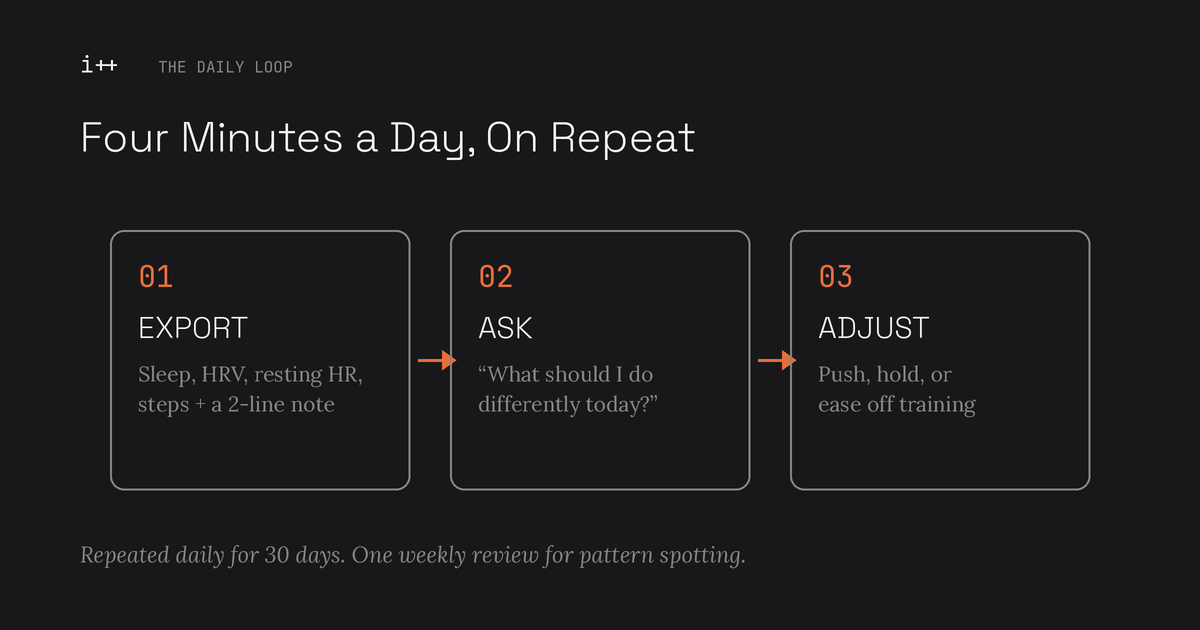
Every day I handed it my sleep data, my step count, my resting heart rate, my workouts, and a two line note about how I actually felt. Then I asked it one question: what should I do differently today?
I went in expecting one of two outcomes. Either this would be a gimmick I'd abandon by day nine, or it would quietly change how I make health decisions. It ended up being a bit of both, and the split between what worked and what didn't surprised me. So here's the full, honest recap.
Why I ran this experiment
If you've been reading this blog for a while, you know I sit at a weird intersection. I write about fat loss and health habits on one side, and self-hosted AI and homelab projects on the other. AI health tracking is the one place those two worlds actually collide.
And I had a specific itch to scratch. In my sleep tracking post, I wrote about how I spent months letting a sleep score dictate my mood. The data was fine. My interpretation of it was the problem. So the real question behind this experiment was: is an AI a better interpreter of my health data than I am?
Thirty days felt long enough to get past the novelty phase and short enough that I'd actually finish.
The setup: what I actually used
I kept the stack deliberately boring, because complicated experiments die by week two.
- A wearable I already owned. Nothing new to buy. It tracks sleep stages, resting heart rate, HRV, and steps. If you're choosing one from scratch, my sleep tracking post covers the current options.
- A daily data export. Each morning I pulled the previous day's numbers into a short structured summary. Sleep duration and quality, resting heart rate, HRV trend, steps, workout if any.
- An LLM with a standing prompt. I wrote one careful system prompt at the start and reused it all month. It told the AI my goals, my constraints, my training schedule, and most importantly, what I did not want: no diagnosis, no alarmism, no generic wellness advice.
- A two line subjective note. This turned out to be the secret ingredient. "Slept 7.5 hours but feel foggy" is far more useful context than the number alone.
Total time cost per day: about four minutes. That was a hard requirement. Any system that takes fifteen minutes a day is a system I quit.
What actually changed
Let me give you the real wins first, because there were some, and they were not the ones I predicted.
1. I stopped reacting to single data points
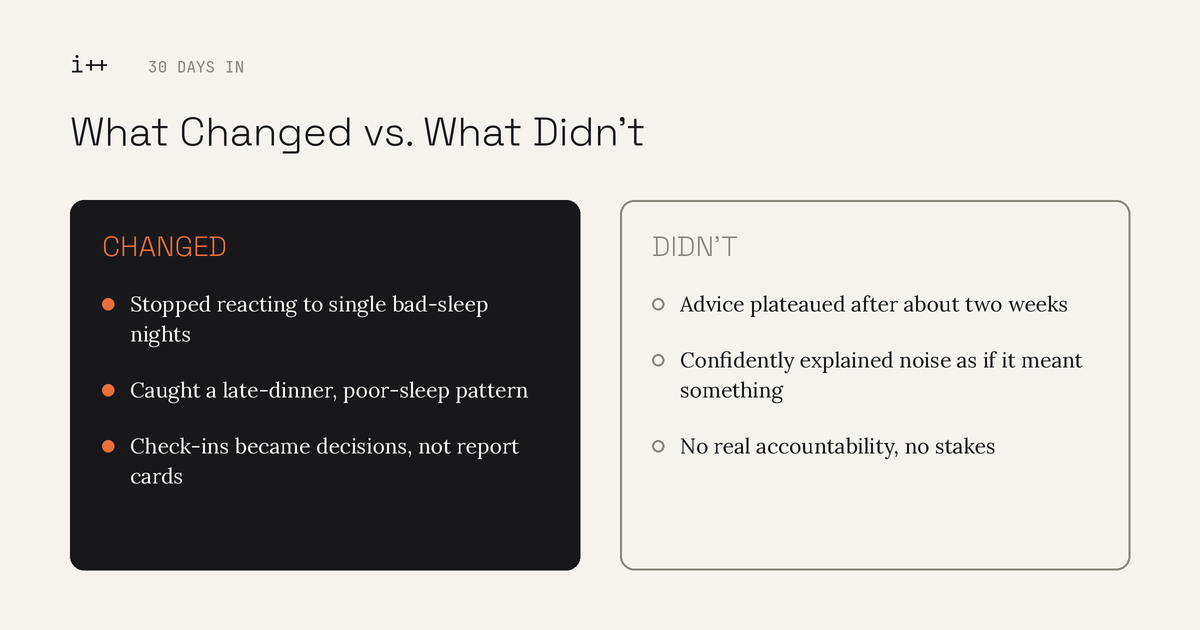
This was the biggest shift. Before the experiment, one bad sleep score could derail my whole day. The AI, because it was looking at rolling seven day windows instead of this morning's number, kept pulling me back to trends. One rough night next to six solid ones is noise. The AI said some version of this over and over until it finally sank in.
Ironic, right? I needed a machine to teach me to care less about the machine's numbers.
2. I caught a pattern I had missed for months
Around day twelve, the AI flagged that my worst sleep consistently followed my late evening lifting sessions, but only when I ate dinner after training instead of before. I had all of this data for months. I had just never held those three variables next to each other at the same time. Humans are bad at spotting interactions across variables. This is exactly the kind of pattern matching AI is genuinely good at.
I moved dinner earlier on training days. My sleep on those nights measurably improved within a week.
3. My check-ins became decisions, not report cards
The daily question "what should I do differently today" reframed everything. Instead of grading yesterday, I was planning today. On days the data said I was run down, the AI suggested swapping intensity for an easy walk. On days everything was green, it nudged me to push. Small adjustments, but they compounded across the month.
What didn't change (and what was pure theater)
Now the other half, because every AI health tracking article that skips this part is selling you something.
The advice ceiling is real. After about two weeks, the recommendations started to converge. Sleep more consistently. Eat protein. Manage stress. Walk. The AI dressed it up differently each day, but the underlying playbook is small because the fundamentals of health are small. If you're hoping AI will reveal some exotic optimization, it won't. It will just make you actually follow the boring stuff.
It confidently over-explained noise. Ask an LLM why your HRV dipped on Tuesday and it will always produce a reason. Always. Even when the honest answer is "single day variance, ignore it." I had to add an explicit instruction to my prompt: it is acceptable and preferred to say the data shows nothing. That one line improved the quality of every response after it.
No accountability effect. I had a theory that reporting to the AI daily would work like a coach checking in. It didn't, at least for me. The AI is infinitely patient and completely unbothered if you skip a workout. Accountability still needs stakes, and a chatbot has none to offer.
How to run your own 30 day version
If you want to try this, here's the whole framework. It's five steps.
- Pick one goal. Better sleep, more consistent training, whatever. One. The AI's suggestions get mushy when you feed it five goals at once.
- Write the system prompt once, carefully. Include your goal, your schedule, your constraints, and the instruction that "the data shows nothing today" is a valid answer.
- Standardize a tiny daily export. Five or six numbers plus a two line note on how you feel. Keep the format identical every day so trends are comparable.
- Ask one question daily: what should I do differently today? Not "analyze my data." A decision question gets you a decision.
- Do a weekly review. Once a week, paste the full week and ask for patterns across days. This is where the real insights live. The daily check-ins are maintenance. The weekly review is discovery.
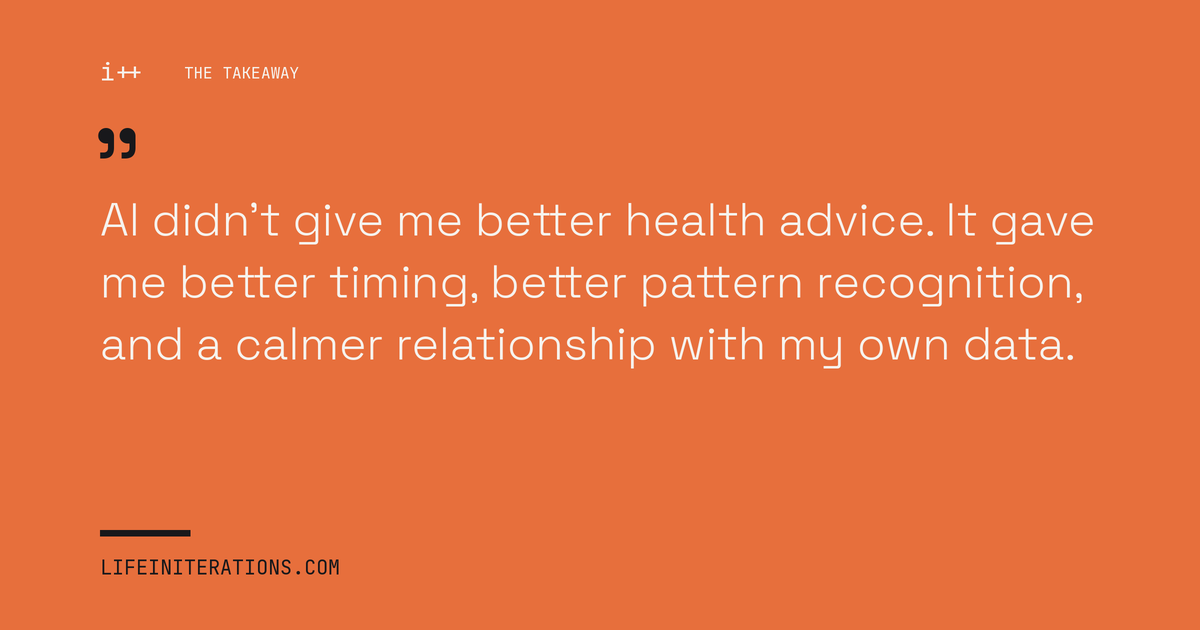
The one sentence version: AI didn't give me better health advice. It gave me better timing, better pattern recognition, and a calmer relationship with my own data. The advice was always the boring stuff. It just finally got me to do it.