How to Stop Food Cravings
Trying to suppress food cravings is a losing battle. The real fix is a smarter eating plan, better habits, and giving yourself permission to actually enjoy food.

You've Been Thinking About This All Wrong
The craving hits. It is 9 PM. You have been eating well all day and then your brain locks onto one specific thing. Maybe chocolate. Maybe biryani. Maybe just something crunchy and salty. And the rest of the evening becomes a negotiation.
You search "how to suppress food cravings." The internet gives you a list: drink water, chew gum, take a walk, distract yourself, wait 20 minutes. And honestly? None of it works in the long run because all of it is treating the symptom instead of fixing the system.
After 15+ months and 20+ KGs down, here is what actually helped me: cravings are a feedback signal, not a character flaw. The goal is not to suppress them: it is to build a way of eating where they stop being a crisis in the first place.
What a Craving Actually Is
Before fixing something, it helps to understand it. A food craving almost always comes from one of two places.
Physiological cravings are your body talking. Common drivers include low blood sugar (that classic mid-afternoon slump), insufficient protein at your last meal, poor sleep the night before, or dehydration. Ghrelin — it’s the hunger hormone which spikes when you are under-slept or under-fuelled, and the brain interprets that spike as a craving for high-reward food, not a craving for a salad.
Habitual and psychological cravings are your brain pattern-matching. You have eaten chips every Friday while watching something on the couch. Now your brain has wired that loop so tightly that the couch and the TV together fire the reward circuitry before you are even aware of it. There is no real hunger here. It is just pattern completion.
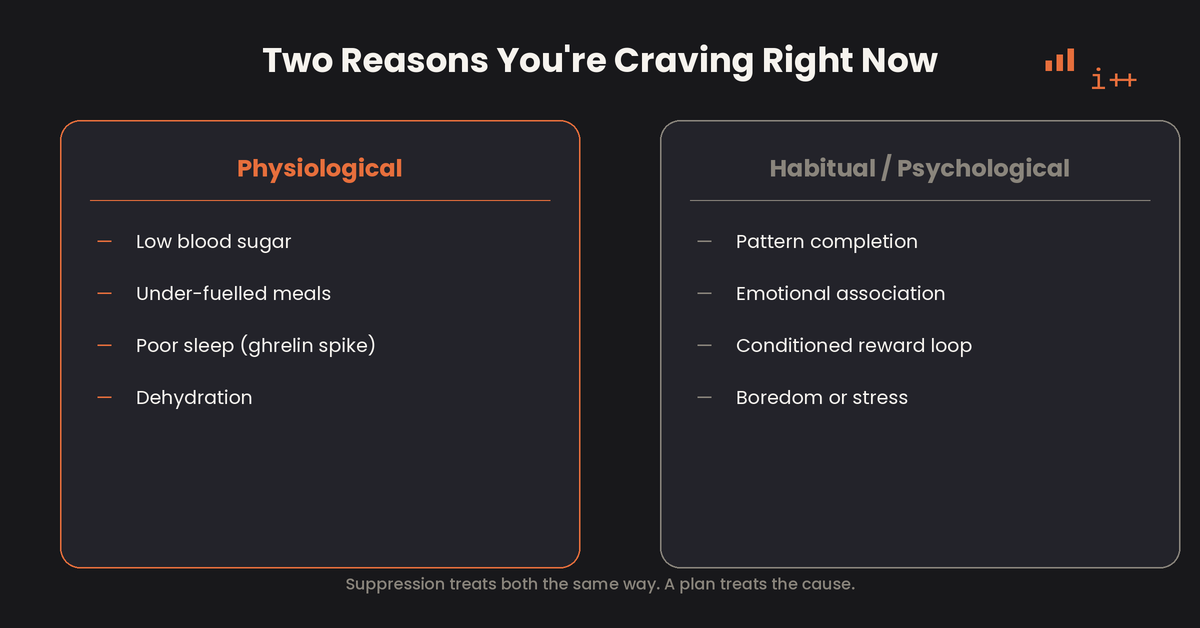
The problem with "suppress" as a strategy is that it treats both types of craving the same way, as enemies to be defeated through willpower. But willpower is a finite resource. You will always lose the late-night battle when you are tired, stressed, and your defenses are down. Suppression is not a system. It is just delay.
Fix 1: Smart Food Planning Takes Away the Crisis
In the first post of this series, I covered TDEE and the idea that your daily calories are a budget. Once you understand your budget, something shifts. You start treating food as something to plan around, not something to fear.
This is the single biggest change that quieted my cravings. Here is why it works.
Most cravings happen in a vacuum. You are hungry, you have not thought about your next meal, you are tired from work, and your brain reaches for the most familiar, high-reward option it can retrieve. That is not weakness. That is how brains work when they are unoccupied and under-fuelled.
When you plan your meals even loosely, two things happen. First, you are rarely caught genuinely hungry and unprepared; you have food available and you know what is coming next. Second, you can deliberately build in foods you actually enjoy.
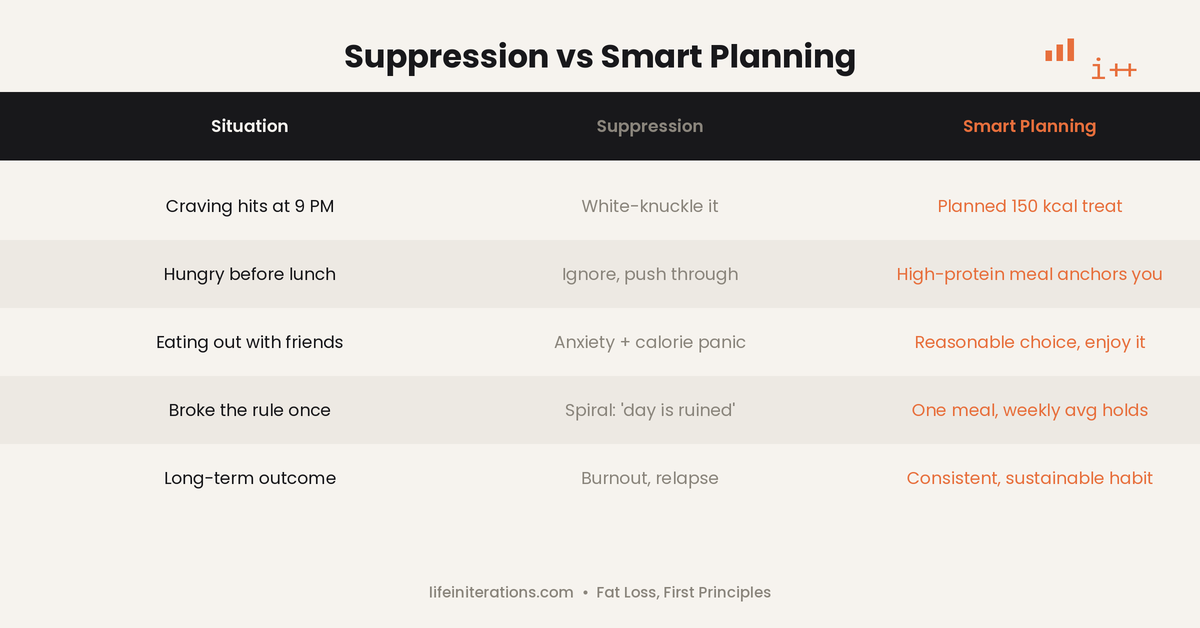
If you know you want something sweet at 9 PM, plan for it. A 150-calorie chocolate square that fits your daily numbers is infinitely better than a guilt spiral after the first craving breaks your resolve and you eat three times as much in a panic. Planned indulgence is not cheating. It is design.
This is what the IIFYM (If It Fits Your Macros) concept gets right: the food you choose does not have to be perfect, it just has to fit the budget. A rigid "clean eating only" rule will eventually meet reality, break, and take your consistency with it. A flexible plan that has room for real food survives contact with real life.
Fix 2: Build Eating Habits, Not Eating Rules
Rules are brittle. "I will never eat bread" is a rule. It fails at the first social dinner with good bread on the table. Then the rule breaks, and because the rule broke, the entire day is mentally written off.
Habits are durable. "I eat a high-protein breakfast every morning" is a habit. After 60 to 90 days, it does not require willpower. It just happens because that is what you do in the morning.
The research on habit formation is clear: you do not need to be perfect, you need to be consistent. A behaviour repeated consistently in the same context eventually becomes the path of least resistance. The friction disappears.
Here are the three habits that did the most work for me when it came to cravings specifically.
Protein at every meal. As I covered in the protein post, adequate protein — 1.6 to 2.2g per kg of body weight — keeps you fuller for longer, reduces ghrelin, and protects muscle mass in a deficit. When your meals are protein-anchored, you are not chasing carbs at 11 PM because lunch actually held you.
Eating at roughly consistent times. Your body gets predictable hunger signals when you eat on a regular schedule. Irregular meal timing creates irregular hunger, which feels like random cravings but is really just your body not knowing what to expect. Rhythm matters more than the specific times.
Owning your food environment. If chips are on the counter, you will eat chips. If Greek yogurt is in the fridge and chips are not in the house, you will eat Greek yogurt. Cravings follow the path of least resistance. The single most effective craving intervention is not willpower; is a grocery run where you buy what you want your default to be.
Fix 3: Eating Out Is Not the Enemy
Here is a belief I had to unlearn. Eating outside your plan, at a restaurant or with friends or at a family dinner, means you have ruined your progress.
It does not. Not even close.
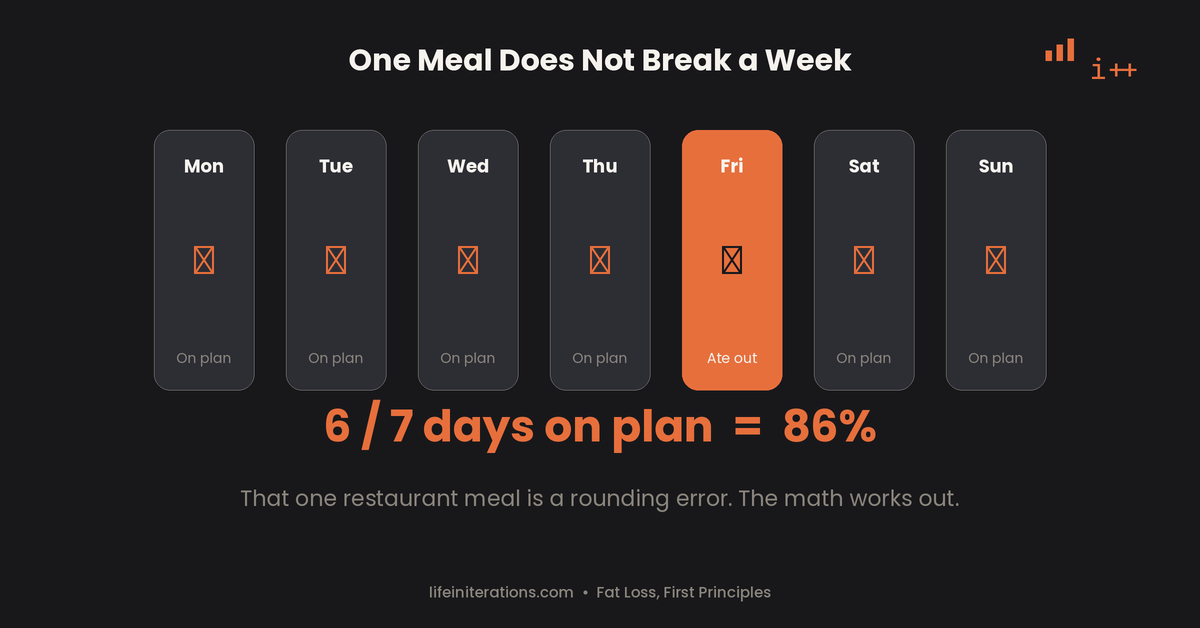
Eating out once or twice a week, even without exact calorie tracking, is not what makes fat loss hard. What makes fat loss hard is the story you tell yourself after the meal. The "I have already broken my streak today, might as well go all in" spiral is where the real damage happens. That spiral is not caused by the meal. It is caused by an all-or-nothing mindset that treats one imperfect choice as a binary fail.
Think in weekly averages, not daily perfection. If you are eating in a sensible deficit 85 to 90% of the time, one restaurant meal is a rounding error in your weekly numbers. The math does not care that it happened on a Wednesday.
And practically, eating out has real benefits. It is social. It is enjoyable. Food is tied to culture, connection, and celebration. A fat loss journey that treats every restaurant meal as a threat will burn you out faster than any calorie deficit.
The skill to develop is not avoiding restaurants. It is making reasonable choices when you are there. Lean toward protein-forward dishes. Skip the extra bread if you are not particularly enjoying it. Drink water with your meal. But do it because it is a reasonable choice, not because you are white-knuckling through a punishment.
One meal does not make a body. One workout does not make fitness. Both things are equally true.
The Mental Model That Changed Everything
Stop asking: "How do I suppress this craving?"
Start asking: "Is my eating plan actually working for me? Am I eating enough protein? Am I sleeping enough? Have I built in foods I enjoy, or am I running on restriction?"
Chronic cravings are a signal that something upstream is off — in your nutrition, your meal timing, your sleep, your stress levels, or your plan. Fix the input, and the craving volume turns down on its own.
Suppression is fighting symptoms. Planning, habits, and flexibility are fixing causes.
What This Looks Like in Practice
This is the actual checklist. No willpower hacks, no 20-minute cold water challenges.
- Plan your day loosely, especially around your high-craving windows (post-dinner is the most common)
- Build in one thing you genuinely enjoy every day, within your calorie budget — not as a reward, just as part of the plan
- Eat at consistent times so your hunger becomes predictable
- Hit your protein targets — 1.6 to 2.2g per kg of body weight keeps hunger quiet
- Eat out without guilt — once or twice a week is not a problem, it is a sustainable life
- When a craving hits, pause and ask: is this physiological hunger, a habit loop, or stress? The answer changes what you do about it
That is the whole system. A plan flexible enough to include real food, habits that run on autopilot, and the ability to eat a meal outside your kitchen without it becoming a crisis.
Cravings do not need to be suppressed. They need to be made irrelevant.
If you missed the protein post, that one is worth going back to because protein is doing most of the heavy lifting on the craving front