Sleep Tracking in 2026: What the Data Actually Tells You (And What It Doesn't)
A tracker can tell you how you slept. It can't make you sleep. Here's what the 2026 sleep tracker data actually means, and the ritual that does the real work.

I spent about four months treating my sleep tracker like a report card. Every morning I'd wake up, check my score, and let it decide how my day was going to go. A 92 meant I could take on the world. A 61 meant I'd walk around feeling like I was fighting a losing battle before I even had coffee.
Here's the thing I eventually figured out. The device was never the problem. My relationship with the number was.
If you've picked up a sleep tracker in the last year, or you're thinking about it, this post is for you. I'm going to walk through what these devices are actually good at, where they fall short, which ones are worth your money in 2026, and the one habit that matters more than any of them: the sleep ritual.
What Sleep Trackers Are Actually Measuring
Most consumer sleep trackers estimate your sleep stages (light, deep, REM, and awake time) using a mix of movement data (accelerometer) and heart rate variability. None of them are hooked up to your brain the way a clinical sleep study is. They're inferring, not measuring directly.
That doesn't mean the data is useless. It means you should treat it the way you'd treat any estimate: directionally useful, not gospel. A study that put Oura, Whoop, Apple Watch, Fitbit, and Garmin against actual polysomnography (the clinical gold standard) found that Oura and Whoop were the strongest at picking up night to night changes in REM and light sleep, while Apple Watch was solid at detecting when you were actually awake but weaker on deep sleep. Fitbit and Garmin showed more variation depending on the night.
The takeaway for me was simple. One bad sleep score doesn't mean much. A pattern across two or three weeks means a lot. That's where trackers earn their keep, not in nightly verdicts but in trends: how alcohol shifts your HRV, how a late workout pushes your bedtime, how a stressful week shows up in your resting heart rate before you consciously notice you're stressed.
What the Data Can't Do For You
Here's the part that took me way too long to internalize: no tracker, no matter how good the sensors are, can make you fall asleep. It can tell you that you didn't sleep well. It cannot fix the reason why.
That reason, for almost everyone, comes down to a handful of unglamorous habits. This is where the actual engineering happens, not in the app, but in the 90 minutes before you close your eyes.
The Sleep Ritual: Training Your Mind and Body
Falling asleep isn't a switch you flip. It's a trained response, the same way your body learns to expect a meal at a certain time or learns to wake up without an alarm if you keep a consistent schedule. The ritual is how you build that trained response on purpose instead of leaving it to chance.
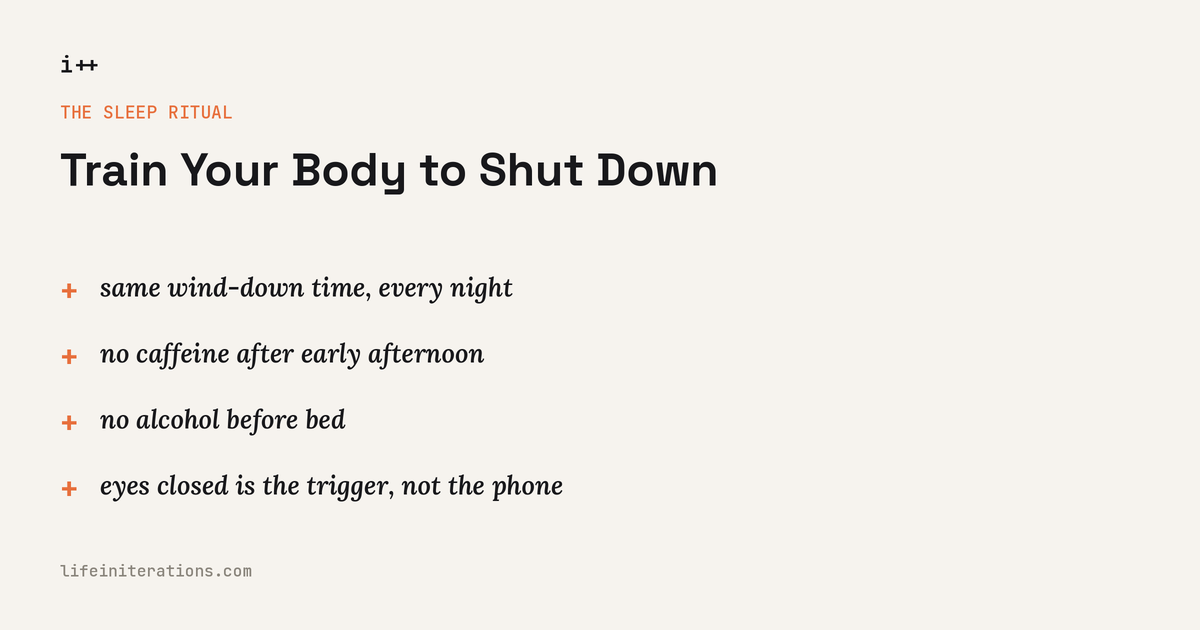
Here's what mine looks like, and what I'd recommend you build toward:
- Pick a wind-down time and protect it like a meeting you can't miss. Not a bedtime, a wind-down time. This is when the lights dim, the phone goes down, and the signal to your nervous system starts. Consistency here matters more than the exact time you choose. Your circadian rhythm cares about repetition, not perfection.
- No caffeine in the second half of your day. Caffeine has a half-life of roughly 5 to 6 hours, which means a 3pm coffee is still meaningfully in your system at 9pm. If you're someone who says caffeine doesn't affect your sleep, it's worth testing that assumption for two weeks before you decide it's true.
- No alcohol before bed. This one surprises people because alcohol feels like it helps you fall asleep faster. It does, initially. Then it fragments your sleep architecture in the second half of the night, cutting into REM and leaving you with more awakenings you probably don't remember. If you're chasing a better sleep score, this is usually the single biggest lever, bigger than any tracker feature.
- Shutting your eyes, consistently, is the actual mechanism. This sounds almost too simple to write down, but it's the most reliable tool you have. The habit isn't "use an app to relax" or "follow a complicated routine." It's closing your eyes at the same point in your wind-down every night and letting that action itself become the cue. Your brain learns to associate eyes closed, lights low, same time, with the process of falling asleep. Over weeks, that association gets strong enough that you stop needing anything else.
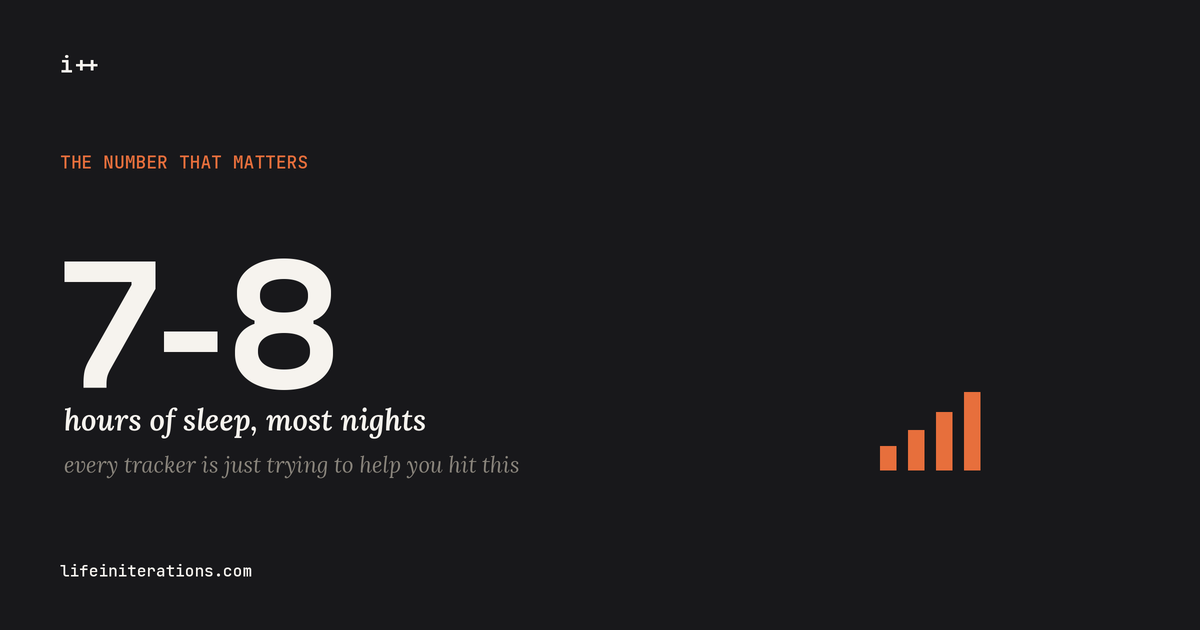
- Aim for 7 to 8 hours, and build backward from your wake time. Instead of guessing at a bedtime, pick your wake time first, count back 7 to 8 hours, and that's your actual target. This is a small mental shift but it makes the ritual concrete instead of aspirational.
Bringing It Together
The way I use my tracker now is completely different from how I used it four months in. I don't check the score first thing anymore. I look at trends once a week: is my HRV trending up or down, is my resting heart rate creeping up, did the two nights I drank line up with worse deep sleep. The device is a mirror for patterns I'm already trying to build through the ritual, not a coach yelling at me about last night specifically.
If you're starting from zero, my advice is to build the ritual first and add the tracker second. The ritual is free. It's also the thing that actually moves the number, no matter which device is on your wrist or your finger when you wake up.
If you're new here, I've been documenting this whole process (fat loss, habits, the engineering mindset applied to a body instead of a codebase) since March 2025. Worth digging through the archive if this is the kind of thing that clicks for you.
This post is part of the ongoing series on training habits like systems. Sleep is the input almost everything else depends on, so it felt like a good one to get right.